
Lancaster County and the countryside around it are full of long driveways. Farmhouses set back from the road, homes on a hill with a drive that winds up through the lawn, properties at the end of a private lane through the trees. These driveways are a big investment, and because they are long, they take a long time to repave when they fail. Keeping them sealed is the cheapest way to make them last.
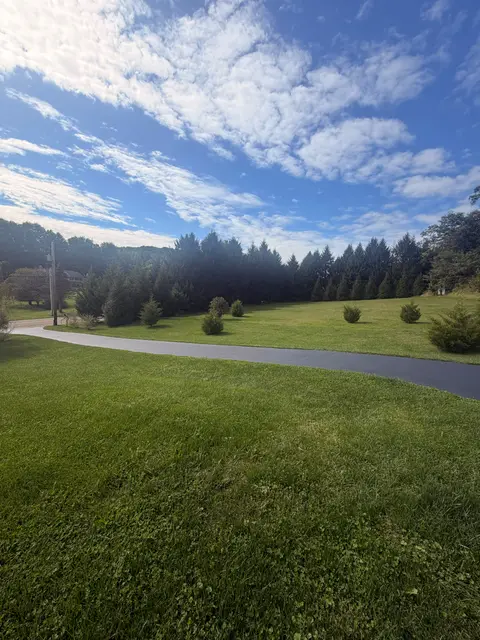
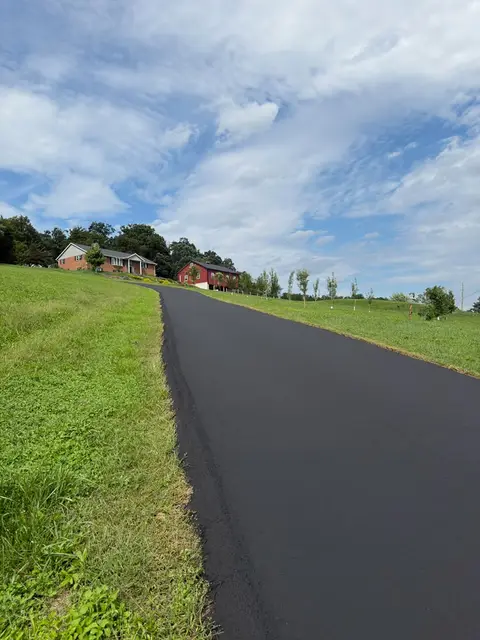
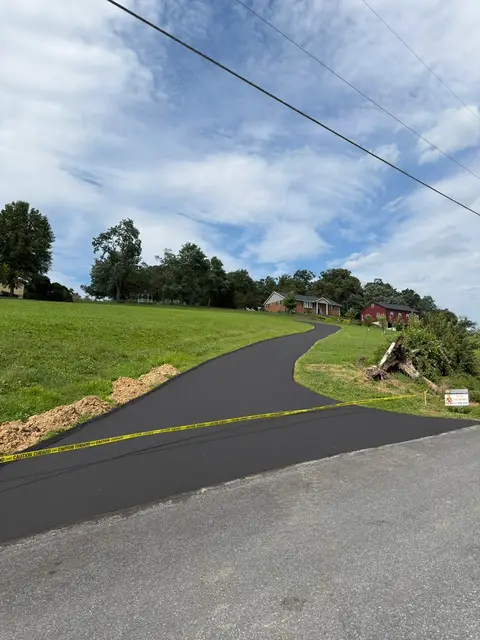
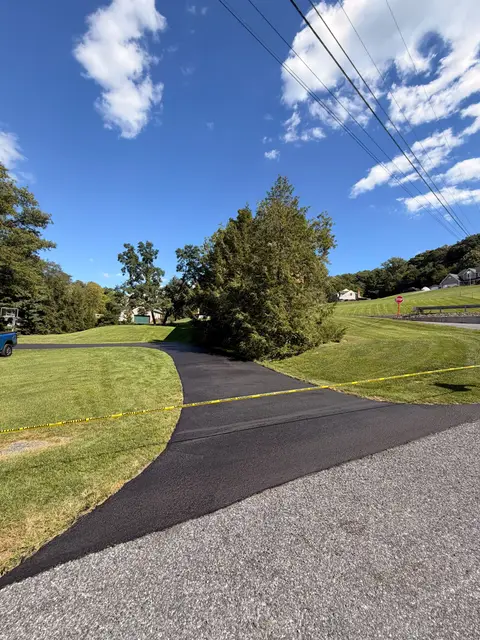
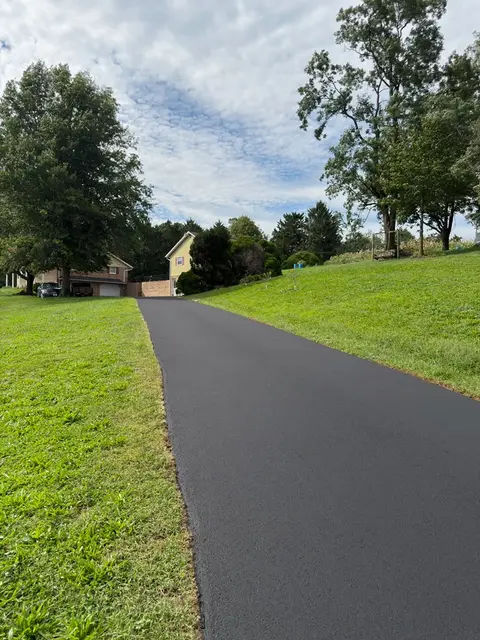
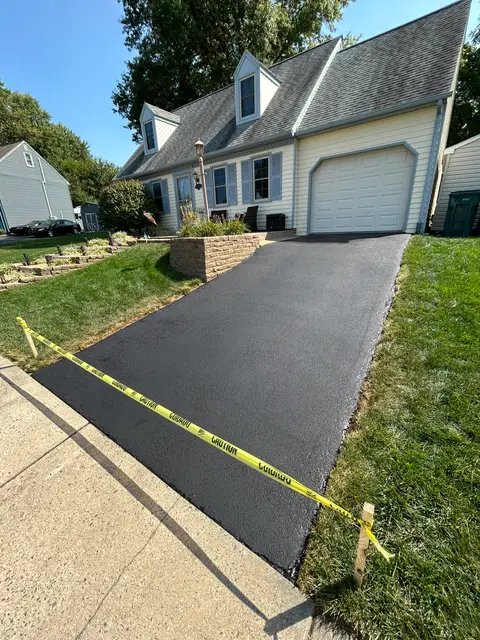
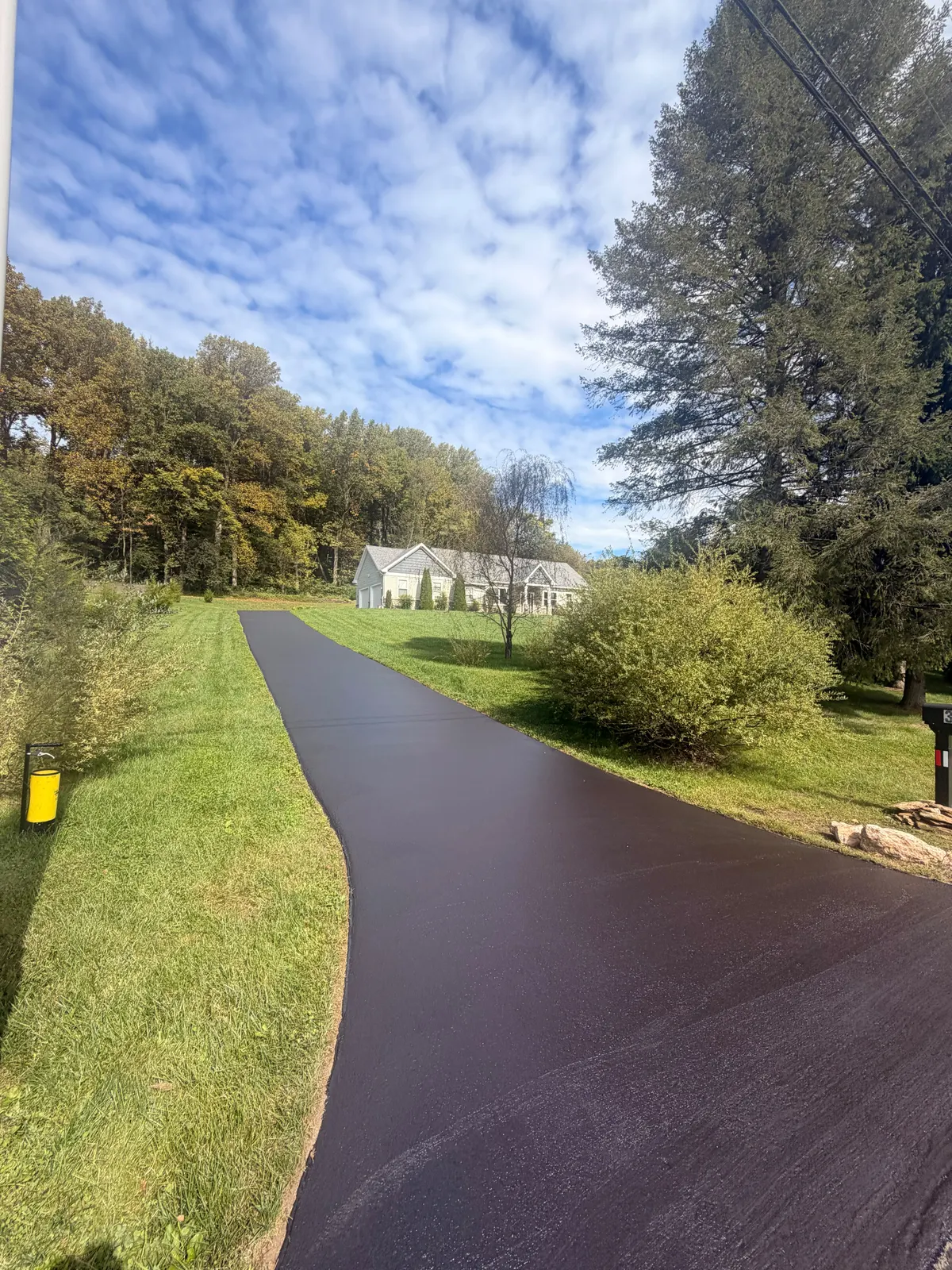
This project page brings together several long driveways sealed by our crew, photographed right after the work. They show the deep black finish, the clean edges along the grass and the tape at the road where the fresh sealer was protected while it cured.
What is different about a long driveway
The process is the same as any driveway: clean, prime oil spots, fill cracks, cut the edges, apply two coats, let it cure. What changes is the scale of the parts that are easy to get wrong.
Edges, and a lot of them
A long driveway bordered by lawn on both sides has hundreds of feet of grass edge. Grass grows over asphalt edges, hides the true edge, and traps moisture against it. Before sealing, the edges are trimmed back so the sealer reaches the real edge of the asphalt. Then the full length is cut in by hand with a brush, so the line between black asphalt and green grass is straight. On a long drive, the edge work takes as much time as the coats.
Slopes
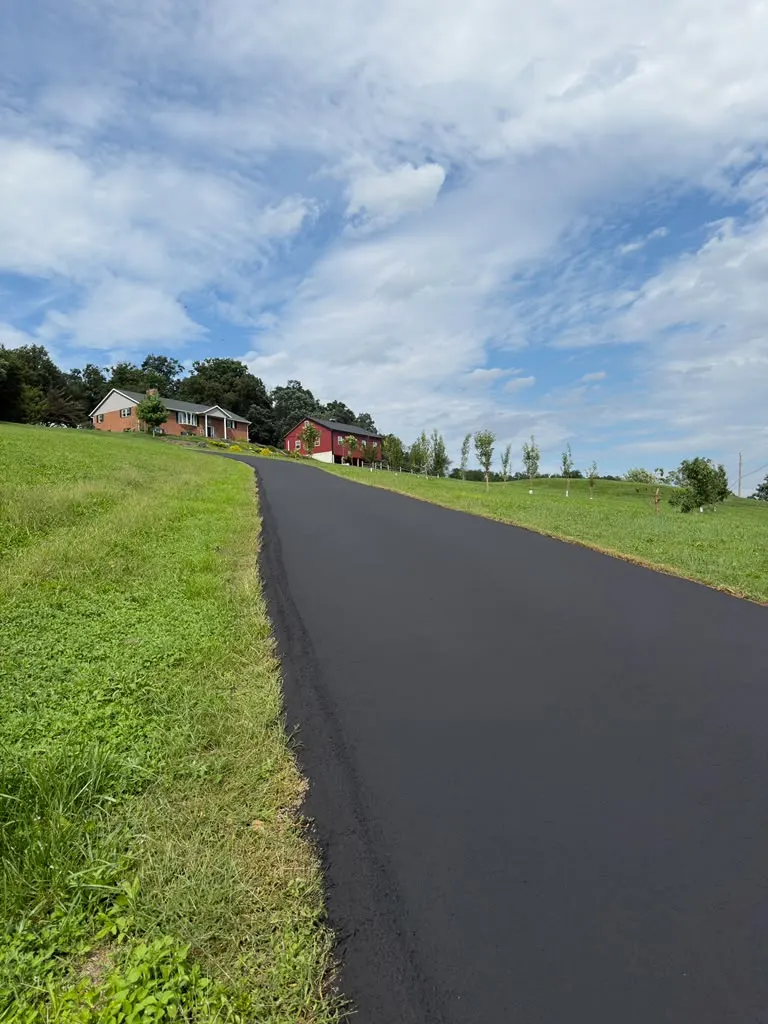
Many country driveways climb from the road to the house. On a slope, sealer applied too heavily runs downhill and collects at the bottom, leaving a thin coat at the top and a thick, slow curing band at the low end. The fix is thin coats applied from the top down, with an eye on the low edge.
The road apron
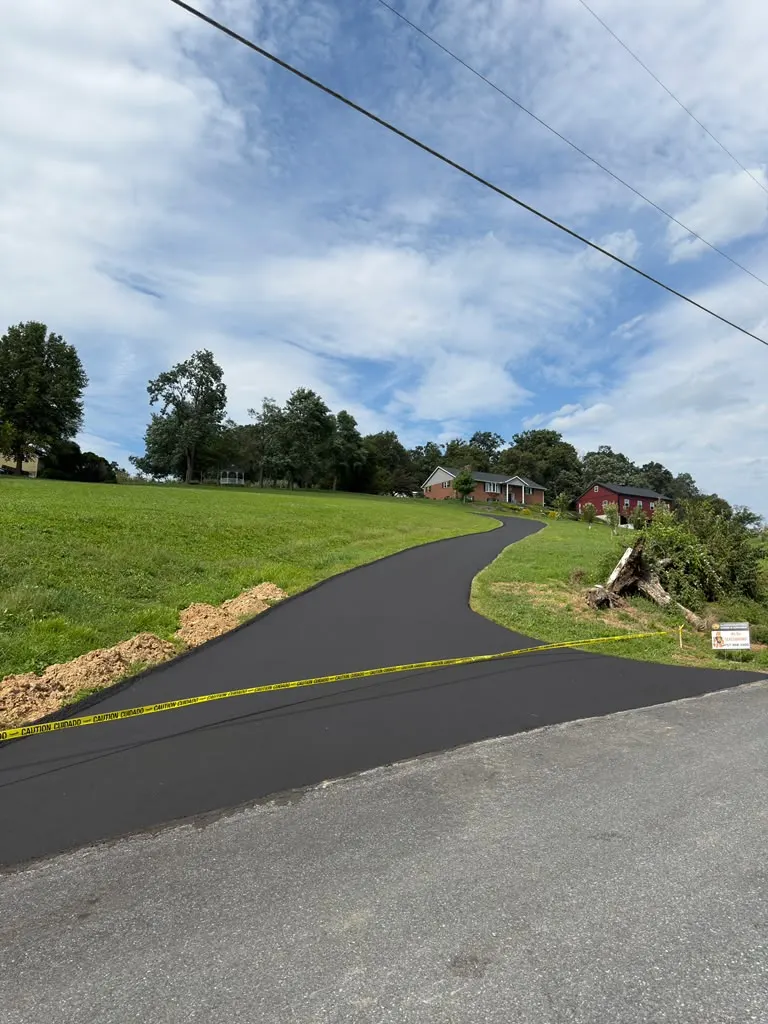
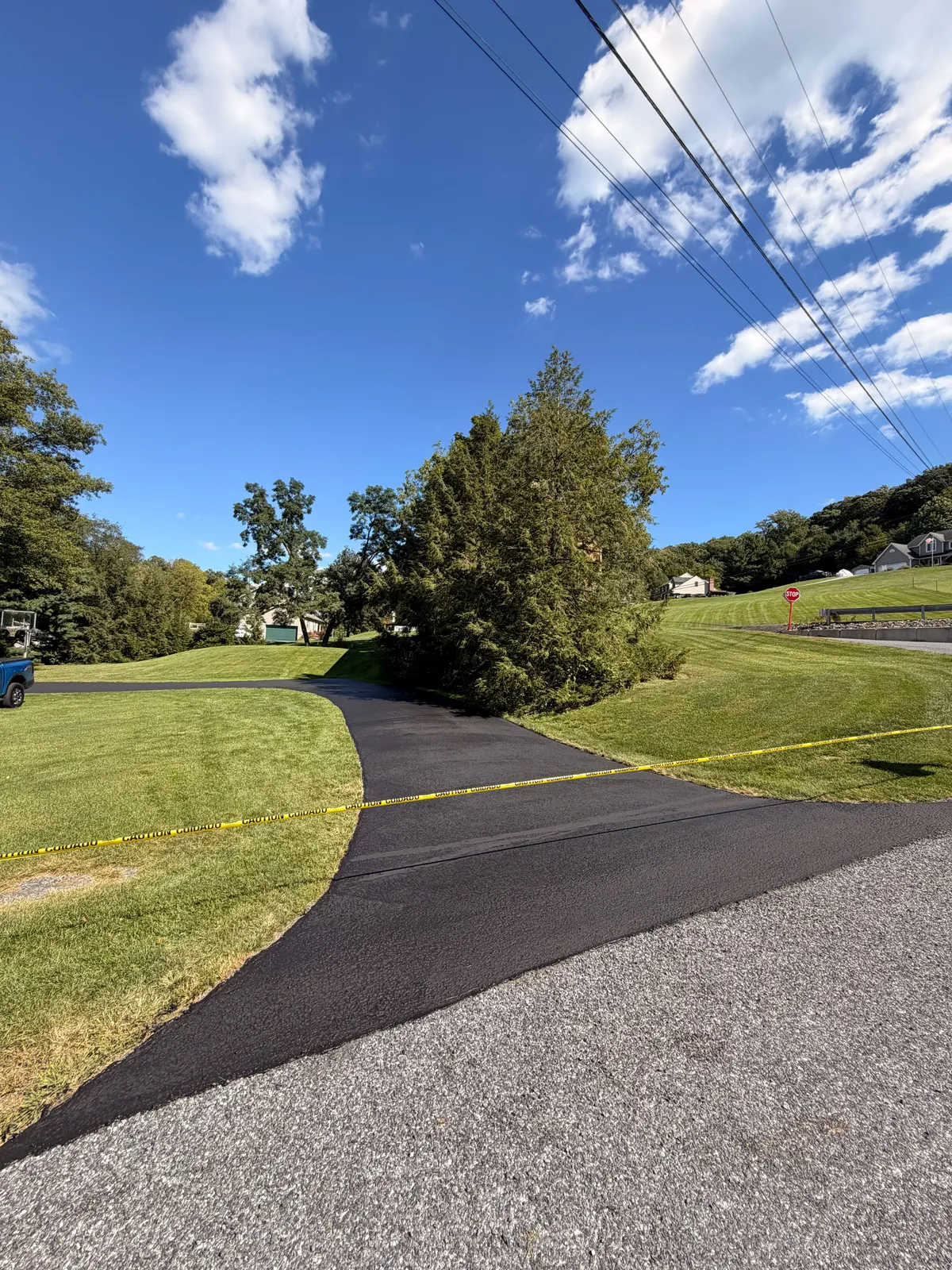
Where the driveway meets the road is the part that takes the most punishment. Cars turn onto it, snow plows push across it, and the edge of the road often has a lip or a seam. The apron is also where people are most likely to drive onto fresh sealer by mistake. In the photos, the road end of each driveway is taped off: that tape is not decoration, it is what keeps a delivery truck from turning onto a coat that has not cured yet.
Curing over a long distance
A long driveway may sit partly in full sun and partly under trees. Shaded sections cure more slowly than sunny ones. The homeowner gets a cure time based on the slowest part of the driveway, not the fastest.
What the finished driveways show
Look at the photos and a few things stand out.
- Uniform black color from end to end, with no streaks or thin patches where the old gray shows through.
- Straight grass edges, cut in by hand along the full length.
- Clean transitions where the driveway meets concrete walkways and garage aprons.
- Tape at the road while the sealer cures.
Why sealing matters more on a long driveway
The longer the driveway, the more it costs to repave, and the more it pays to keep the one you have in good shape.
Asphalt breaks down for the same reasons everywhere: sun dries out the binder, water gets into cracks and freezes, and the surface slowly loses its strength. On a long rural driveway, there are often extra stresses: farm equipment, delivery trucks, runoff from the lawn and fields, and edges with no curb to support them. Sealing on a three to four year cycle, with cracks filled before each coat, slows all of that down.
How to keep a long driveway in shape
- Walk it every spring. A long driveway hides damage. Look for new cracks, crumbling edges and potholes, especially at the road and near the garage.
- Fill cracks every fall before the freeze and thaw season.
- Keep the edges trimmed so grass does not grow over the asphalt.
- Mark the edges for the plow with stakes in late fall, so the plow driver can see where the asphalt ends.
- Watch the drainage. Water running down a sloped driveway or across it from the lawn will find the weak spots. Ditches and culverts along the drive should be kept clear.
- Seal every three to four years, not every year.
Our asphalt driveway maintenance schedule lays this out season by season.
Getting a long driveway ready for sealing day
- Move every vehicle off the driveway, including anything that will need to come out of the garage in the next two days.
- Plan where cars will park during the cure, usually at the road or on a neighbor's drive.
- Turn off sprinklers and keep them off until the sealer cures.
- Tell delivery services that the driveway is closed for a day or two.
- Trim the edges if the grass has grown far over the asphalt.
Our checklist for sealcoating day covers the rest.
Lessons from long driveways
- The edges make the job. On a long driveway, the hand-cut grass edge is what people notice first.
- Slopes need thin coats. Heavy coats run.
- The road apron needs protection. Tape it off and keep traffic away while it cures.
- Plan for the slowest curing section. Shade adds time.
- Seal on a schedule. Repaving a long driveway is a large project; regular sealing pushes it much further out.
Questions homeowners ask about long driveways
Does a long driveway take more than a day?
Most can be done in a day, depending on length, condition and how much crack filling and edge work is needed.
Can I still get out while it cures?
Plan to park at the road or somewhere off the driveway for the cure time, usually 24 to 48 hours.
Do you seal the part at the road?
Yes, the full length to the edge of the road, unless the homeowner or the municipality wants it to stop at a particular line.
My driveway has gravel shoulders. Is that a problem?
No. The sealer stops at the edge of the asphalt. Loose gravel is cleaned off the surface before sealing.
How often should a long driveway be sealed?
Every three to four years, with cracks filled before each coat.
Common problems on long rural driveways
Long driveways in the country tend to share the same set of problems. Knowing them helps you catch them early.
Edge breakup. With no curb to hold it, the edge of a long driveway slowly crumbles, especially where cars pull over to pass or tires run off the asphalt. Once the edge starts to go, water gets under the pavement from the side. Keeping the grass trimmed and filling soil back along washed out edges helps.
Runoff damage. A driveway that runs down a hill carries water. If the water runs down the middle of the drive or cuts across it at the low spots, it washes fines out of the base and opens cracks. Swales, culverts and ditches along the drive need to stay clear.
Tree roots and shade. Driveways through wooded lots get root bumps and cracks near big trees, and shaded sections stay damp longer, which encourages moss and slows curing after sealing.
Heavy vehicles. Farm equipment, delivery trucks, propane deliveries and trash trucks put far more load on a driveway than cars. The spots where they turn or stop wear first.
Plow damage. A long driveway is often plowed by a contractor with a truck. Without edge markers, the blade catches the edges and the road apron.
None of these mean the driveway is failing. They are the places to watch, and most of them can be handled with crack filling, small repairs and regular sealing.
Why a long driveway is worth the edge work
On a short driveway, a ragged edge is a few feet of imperfection. On a long country driveway, it is hundreds of feet, and it is the first thing anyone driving up to the house sees. That is why we treat the edge on a long drive as part of the finished product, not a detail. Trimmed grass, a straight hand-cut line and no sealer on the lawn are what make a long driveway look new rather than just darker.
Details
- Several long rural and country driveways bordered by lawns, tree lines and fields.
- Sealcoated end to end with straight, hand-cut grass edges.
- Road aprons taped off while the sealer cured.
- Photographed right after the work, showing the uniform black finish.
Lancaster Lines & Asphalt seals driveways of every length across Lancaster County, from short in-town drives to long country lanes. See our driveway sealing and sealcoating page, read driveway sealing vs. sealcoating for what the different names mean, or request a free quote.