A fire lane is the simplest marking on your property and the one most likely to be wrong. The curb is faded to pink, half the letters are gone, a dumpster has been sitting in the lane since spring, and nobody is quite sure whether the lane was supposed to be red or yellow in the first place. Then the fire marshal visits, or an insurance inspector, and suddenly it matters.
This guide explains how fire lanes work in Pennsylvania, who makes the rules, what the markings usually have to look like, and how to keep a lane legal year after year. It is written for property owners and managers, not for code officials, so it stays practical.
What a fire lane is
A fire lane is the route a fire truck needs to reach a building and work next to it. The fire code calls it a fire apparatus access road. It has to be wide enough and tall enough for the truck, strong enough to carry it, and close enough to the building for hoses and ladders to reach. The lane exists so that on the worst day your building ever has, the truck is not blocked by a parked car.
Marking the lane is how everyone else finds out it exists. A fire lane that is not marked is a parking spot.
Who decides the rules
This is where most confusion starts, so here is the chain.
Pennsylvania's Uniform Construction Code adopts the model building and fire codes, and the municipality where your property sits enforces them, usually through a code official and the local fire official or fire marshal. The model fire code requires that fire apparatus access roads be marked with approved signs or other approved notices, and that the marking be maintained. The word that matters there is approved. The code official or fire official approves what the marking looks like.
That is why fire lane markings differ from one township to the next. Some want red curbs. Some accept yellow. Some specify the exact wording, letter height and spacing. Some require signs in addition to paint. Your municipality may also have its own fire lane ordinance that adds detail. There is no single statewide drawing of a fire lane that works everywhere in Pennsylvania.
The practical rule: before you paint a fire lane, find out what your township, borough or city expects. We check this on every fire lane job, because painting a lane the wrong color and then repainting it is a waste of everybody's money.
What usually gets marked
Across most municipalities, a fire lane marking has some combination of these elements.
A painted curb. The curb face along the fire lane is painted a solid color, red in most places, yellow in some. The paint runs the full length of the lane so there is no ambiguity about where it starts and stops.
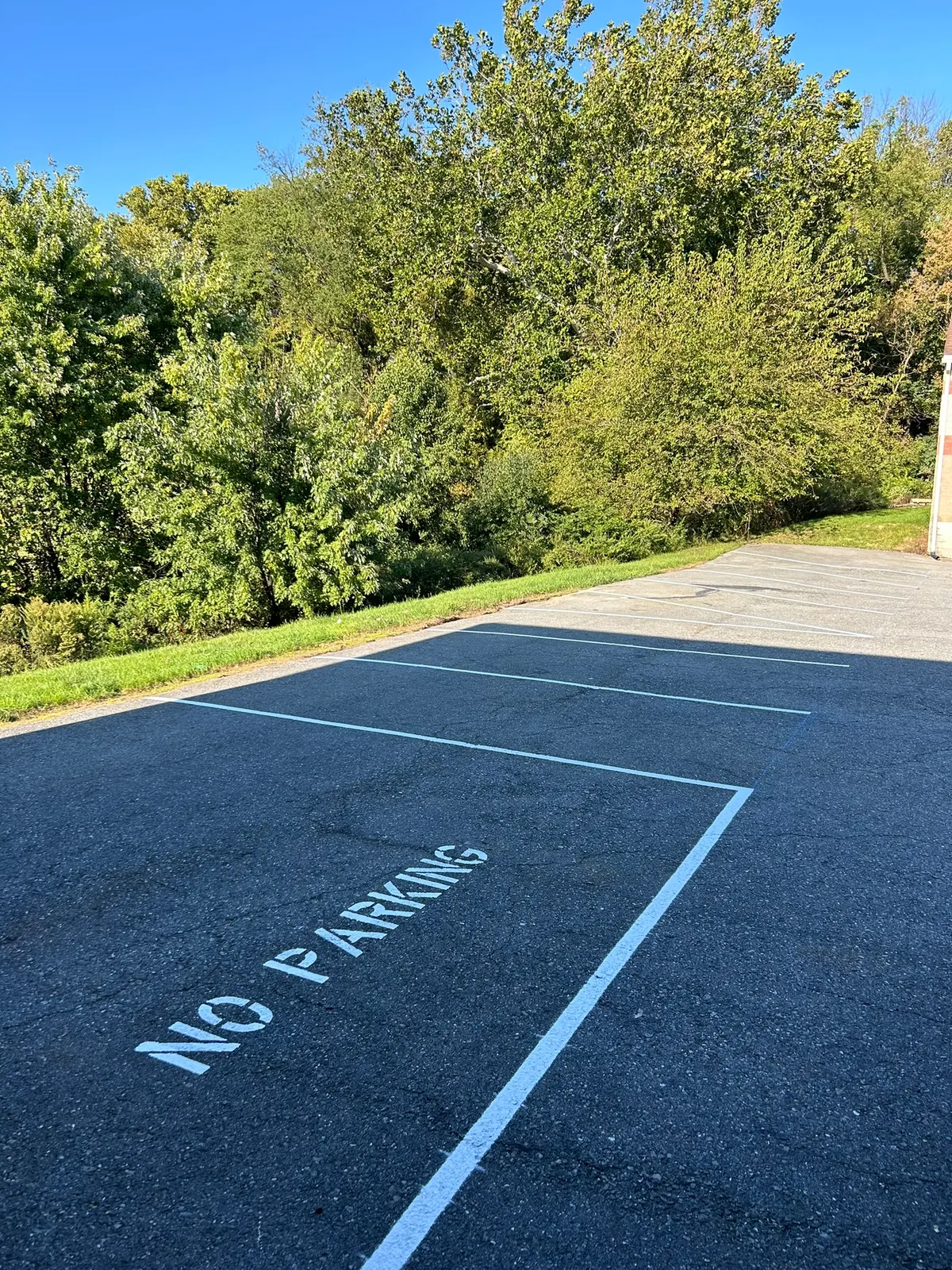
Stenciled wording. Lettering along the curb face or on the pavement, usually reading NO PARKING FIRE LANE or FIRE LANE NO PARKING, repeated at intervals along the lane. Letter height and spacing vary. Many municipalities want letters several inches tall and repeated often enough that a driver cannot park anywhere in the lane without seeing the words.
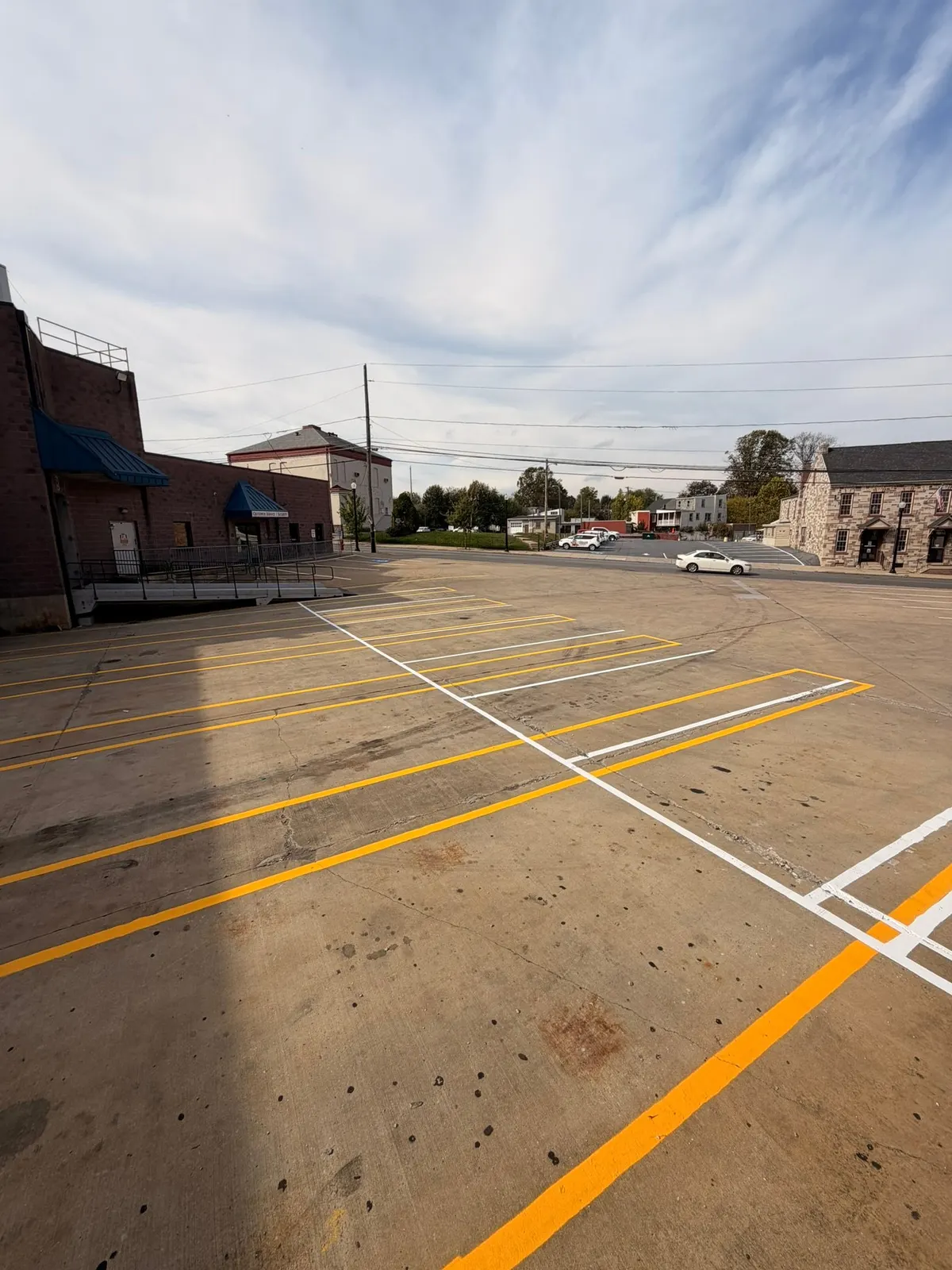
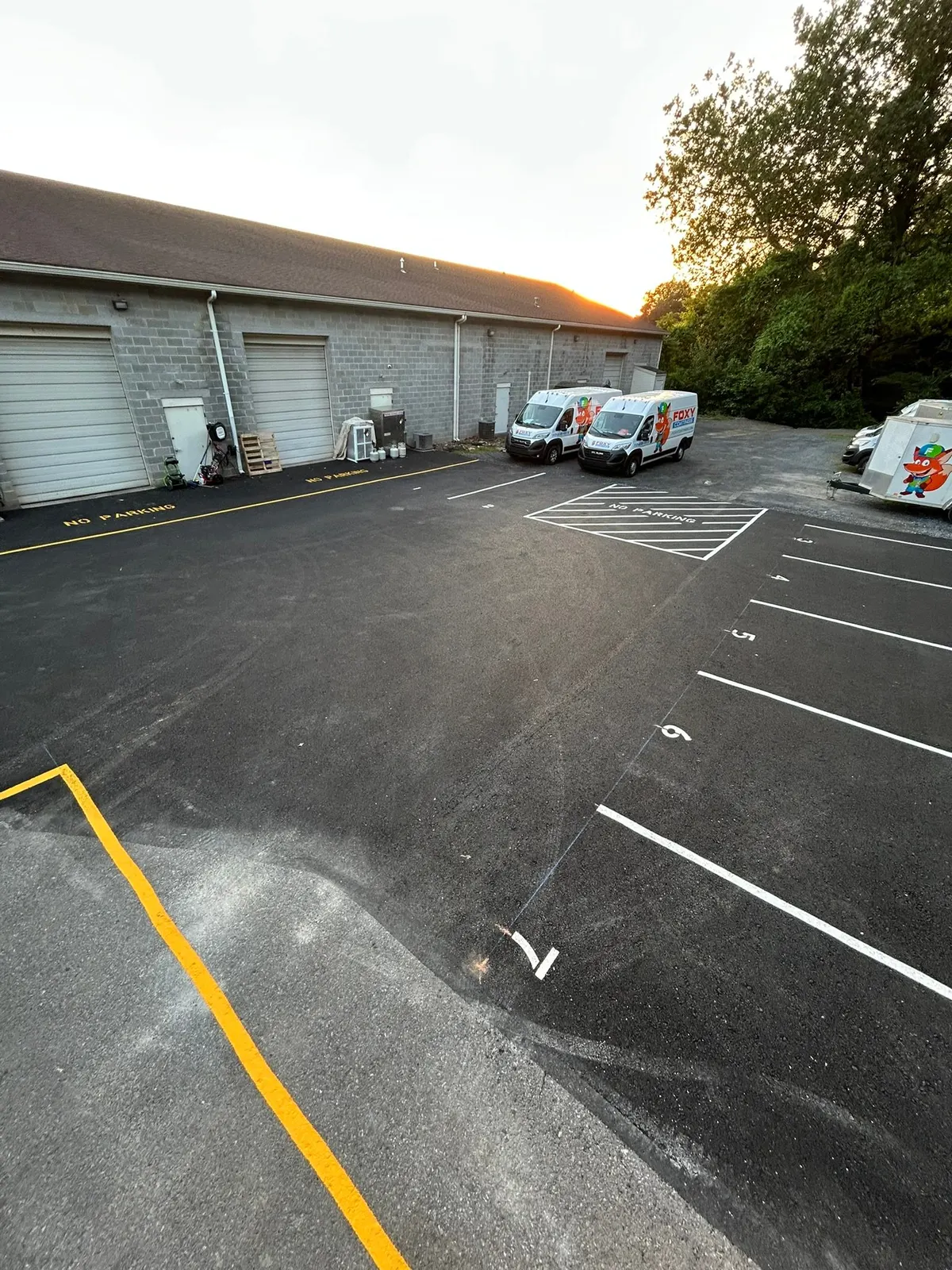
Pavement markings. Where there is no curb, the lane may be outlined on the pavement with a painted line and the wording stenciled on the pavement itself. Some properties use hatching to mark the keep clear area.
Signs. Many municipalities require posted signs at intervals along the lane, in addition to or instead of paint, often because paint disappears under snow. Signs are a separate trade from striping, but a complete fire lane usually has both.
The size of the lane
The model fire code sets minimums for fire apparatus access roads: an unobstructed width of at least 20 feet in most cases, a vertical clearance of at least 13 feet 6 inches, and a surface designed to carry the weight of fire apparatus. Longer dead end roads need turnarounds. Local officials can modify these for specific conditions, and buildings with sprinkler systems are sometimes allowed exceptions.
For an existing property this matters in one way: the lane you mark has to be the lane the fire department can actually use. Marking a 12 foot gap as a fire lane because it looks like one does not help anyone. If you are not sure where the lane is supposed to run, the fire official will tell you, and that conversation is far better before painting than after.
Hydrants and fire department connections
Fire hydrants and fire department connections, the pipe fittings on the building where the truck hooks up, need clear space around them. Many municipalities require a marked keep clear zone, often painted on the curb or pavement, and prohibit parking within a set distance of a hydrant. These are usually painted at the same time as the fire lane.
How often fire lane paint needs attention
Curb paint and stencils take more abuse than parking stall lines because they sit at the edge of the lot where plow blades scrape, salt collects and tires rub. In Lancaster County, expect a painted fire lane to need refreshing every two to three years, and sooner if it is on a busy delivery route or gets plowed hard.
The sign that it is time: the red has gone pink or orange, the lettering is partly gone, and people are parking in the lane because it no longer looks like a lane. A fire lane that cannot be read is treated as unmarked, no matter how good it looked when it was painted.
Common mistakes that get properties cited
- Faded or missing lettering. The most common problem by far. A red curb with no words is just a red curb.
- The wrong color or wording. Painted before anyone checked what the municipality wanted.
- Blocked lanes. Dumpsters, storage containers, delivery pallets and employee parking that have quietly moved into the lane.
- Lanes marked in the wrong place. The painted lane does not match where the fire department actually needs access.
- Paint only, no signs, where the municipality requires signs.
- Markings that stop short. The lane is painted along the front of the building but not around the side where the fire department connection is.
How we handle a fire lane job
Our process is built around getting it right once.
- Check the requirement. We ask what your municipality and fire official expect for color, wording, letter size and spacing, and we look at any previous approval the property has.
- Confirm the route. We walk the lane with you and make sure the marking will follow where the fire department needs access, including hydrants and connections.
- Clean and mask. Curbs are cleaned of dirt and loose paint. Edges are masked for straight lines.
- Paint the curb. A solid, even coat in the required color along the full length.
- Stencil the wording. Letters at consistent height and spacing, placed so they are readable from a driver's seat.
- Walk it and cone it. Every stencil is checked. Cones stay up until the paint is dry.
Signs are a separate trade. We tell you what the signs need to say and where they go, and we can coordinate with a sign installer.
Fire lanes and the rest of your lot
A fire lane is usually painted as part of a larger striping job, and the order of work matters. If the lot is being sealcoated, the sealer goes down first and cures, then the stall lines, fire lane and stencils are painted on top. Painting a fire lane and then sealcoating over it means painting it twice.
If your lot also has ADA stalls, they get checked at the same time. Fire lanes and accessible stalls are the two markings that carry legal weight, and an inspector who looks at one will usually look at the other. Our guide to ADA parking compliance in Pennsylvania covers that side.
For property managers with several sites
If you manage more than one property, keep a simple record for each: the municipality, the approved color and wording, the date the lane was last painted and photos. When the fire official or your insurer asks, you have the answer in a minute. When it is time to repaint, the crew knows exactly what to do without a new round of phone calls.
Frequently asked questions
Does my fire lane have to be red?
Not everywhere. Red is the most common requirement, but some municipalities accept or require yellow, and some have their own standard. Check with your code official before painting.
What should the lettering say?
Most municipalities want NO PARKING FIRE LANE or similar wording, repeated along the lane at intervals they specify. Letter height and spacing vary by municipality.
Do I need signs as well as paint?
Often yes. Paint disappears under snow, so many municipalities require posted signs along the lane. Ask your fire official.
How often should I repaint?
Every two to three years in our climate, sooner on heavily plowed or high traffic lanes. Repaint as soon as the color fades or the lettering becomes hard to read.
Who enforces fire lane parking?
Usually the local police or the fire official, depending on the municipality. Clear markings are what make enforcement possible.
Can you paint the fire lane at night?
Yes. Many commercial properties prefer evenings or weekends so the lane is not blocked during business hours.
Need a fire lane painted or refreshed?
Lancaster Lines & Asphalt paints fire lanes, curbs and keep clear zones for commercial properties across Lancaster County, and we check the municipal requirement before the first can of paint is opened. See the fire lane marking page or request a free quote.