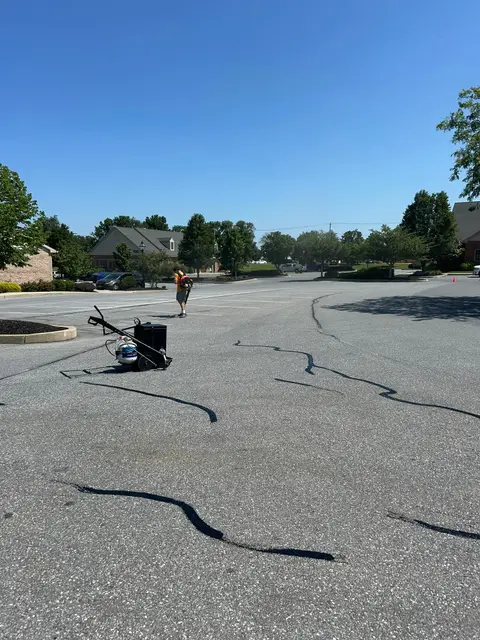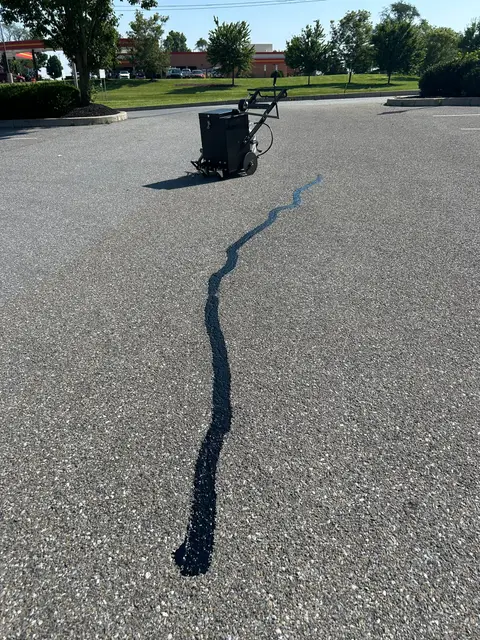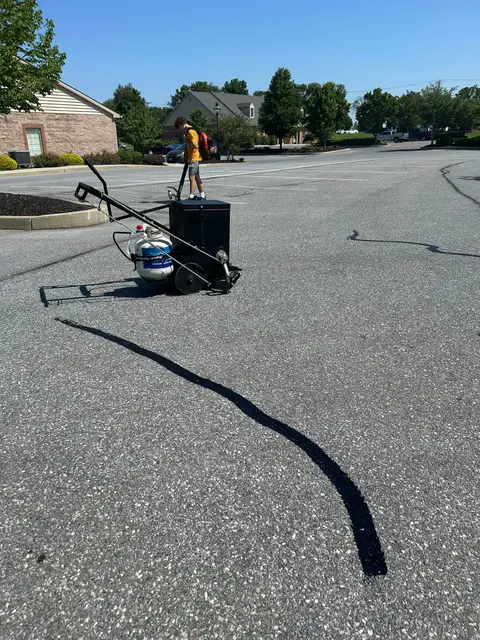
Cracks are the first sign of age in almost every asphalt driveway. They start as hairlines along the edges, then a few run across the middle, and before long there is one that grass is growing out of. Most homeowners notice them in spring, when the snow is gone and the damage from the winter is easy to see.
The good news is that most driveway cracks are cheap to deal with if you deal with them early. The bad news is that the wrong repair, or no repair, lets a small crack turn into a pothole in a couple of seasons. This guide explains how to read the cracks in your driveway, what you can fix yourself, and when a professional repair is the better call.
Why asphalt driveways crack
Asphalt is stone held together by a flexible binder. Over time, three things work against it.
Sun. Ultraviolet light dries out the binder. The surface turns gray and becomes more brittle, so it cracks instead of flexing.
Temperature swings. Asphalt expands in summer heat and contracts in winter cold. That movement, repeated year after year, opens cracks, especially across the width of the driveway.
Water and freezing. This is the big one in Pennsylvania. Water gets into a crack, freezes, expands, and pushes the crack wider. When it thaws, the water drains a little deeper. Lancaster County goes through dozens of these freeze and thaw cycles each winter, and every one of them works on every open crack. We explain the full mechanism in why your driveway gets potholes every spring.
Read the crack before you repair it
Not every crack is the same problem, and not every crack has the same fix.
Hairline cracks
Thinner than a pencil lead. They are mostly in the surface and are usually too narrow to fill. A good sealcoat will bridge them and slow them down.
Single cracks you can fit a coin or pencil into
These are the cracks that matter most. They are open to water, and they are exactly what crack sealing is for. Long cracks across the driveway and cracks along the seam between paving passes fall into this group.
Edge cracks
Cracks running along the outside edge of the driveway, often with the edge crumbling away. They usually come from the edge having no support (no curb, soil washed away, tires driving off the edge). Sealing helps, but the edge may also need rebuilding.
Wide cracks with broken edges
Cracks wider than an inch or so, especially with pieces breaking off, are past simple filling. They often need to be cut out and patched.
Alligator cracking
A web of connected cracks that looks like reptile skin. This means the base under the asphalt has failed. Filling these cracks is a waste of money; the area needs to be removed and rebuilt. If you see alligator cracking, skip ahead to the section on when to call a pro.
Driveway crack repair options
Cold pour crack filler (DIY)
This is the jug or tube of liquid filler from the hardware store. You squeeze or pour it into the crack and it dries by evaporation.
- Good for: small, clean, narrow cracks, as a temporary fix.
- Limits: it shrinks as it dries, becomes rigid, and often pulls away from the sides of the crack within a season or two. It also struggles with cracks that move a lot with temperature.
Hot pour rubberized crack sealant (professional)
A rubberized material heated in a melter to roughly 400 degrees Fahrenheit and poured into the crack. It bonds to the sides and cures into a flexible rubber that moves with the pavement.
- Good for: any crack wide enough to take it, on driveways and lots.
- Limits: needs equipment and experience. The crack still has to be clean and dry.
We compare the two in detail in hot pour vs. cold pour crack filler.
Patching
For wide, broken cracks and failed areas, the damaged section is cut out and replaced with new asphalt. That is an asphalt repair, not crack filling. See cold patch vs. hot mix for how a proper patch is built.
How to seal cracks in your driveway yourself
If you want to handle small cracks on your own, here is how to give the repair its best chance.
- Pick the right day. Dry pavement, no rain in the forecast, and air temperature comfortably above 50 degrees. Many products list their own minimum on the label.
- Clean the crack. Pull weeds, scrape out dirt and loose pieces with a screwdriver or crack hook, then blow the crack out with a leaf blower or compressed air. The filler bonds to whatever it touches. If that is dirt, it will lift out.
- Fill deep cracks partway first. For cracks deeper than the product allows, many manufacturers recommend backer rod or sand in the bottom so the filler is not wasted and cures properly.
- Fill slightly below the surface. Most cold fillers settle as they cure. Follow the label on how full to fill.
- Let it cure fully before driving on it or sealing over it. That can take from hours to more than a day depending on the product and the weather.
- Seal the driveway afterward, if it is due, once the filler has cured.
Done this way, a DIY fix will hold small cracks for a while. Expect to redo it sooner than a hot pour repair.
When to call a professional
- Many cracks, or long ones. If you are looking at a driveway full of cracks, hot pour is faster, cleaner and lasts longer.
- Wide cracks. Anything wider than DIY products are rated for.
- Cracks that came back. If cold filler has already failed once, it will fail again.
- Edge breakup or alligator cracking. These are base problems that need repair, not filling.
- You are planning to sealcoat. The cracks should be filled properly first, and doing both in one visit is efficient.
- A commercial lot or shared driveway. More footage, more traffic, more liability.
The right time of year
Fall is the best season for crack sealing in Lancaster County. Asphalt contracts in cool weather, so cracks are at their widest and take the full amount of material. Sealing them before winter keeps water out during the freeze and thaw months, which is when most damage happens. Spring is the second best time, to catch what winter opened up. We cover this in why fall is crack filling season.
Crack repair and sealcoating: the right order
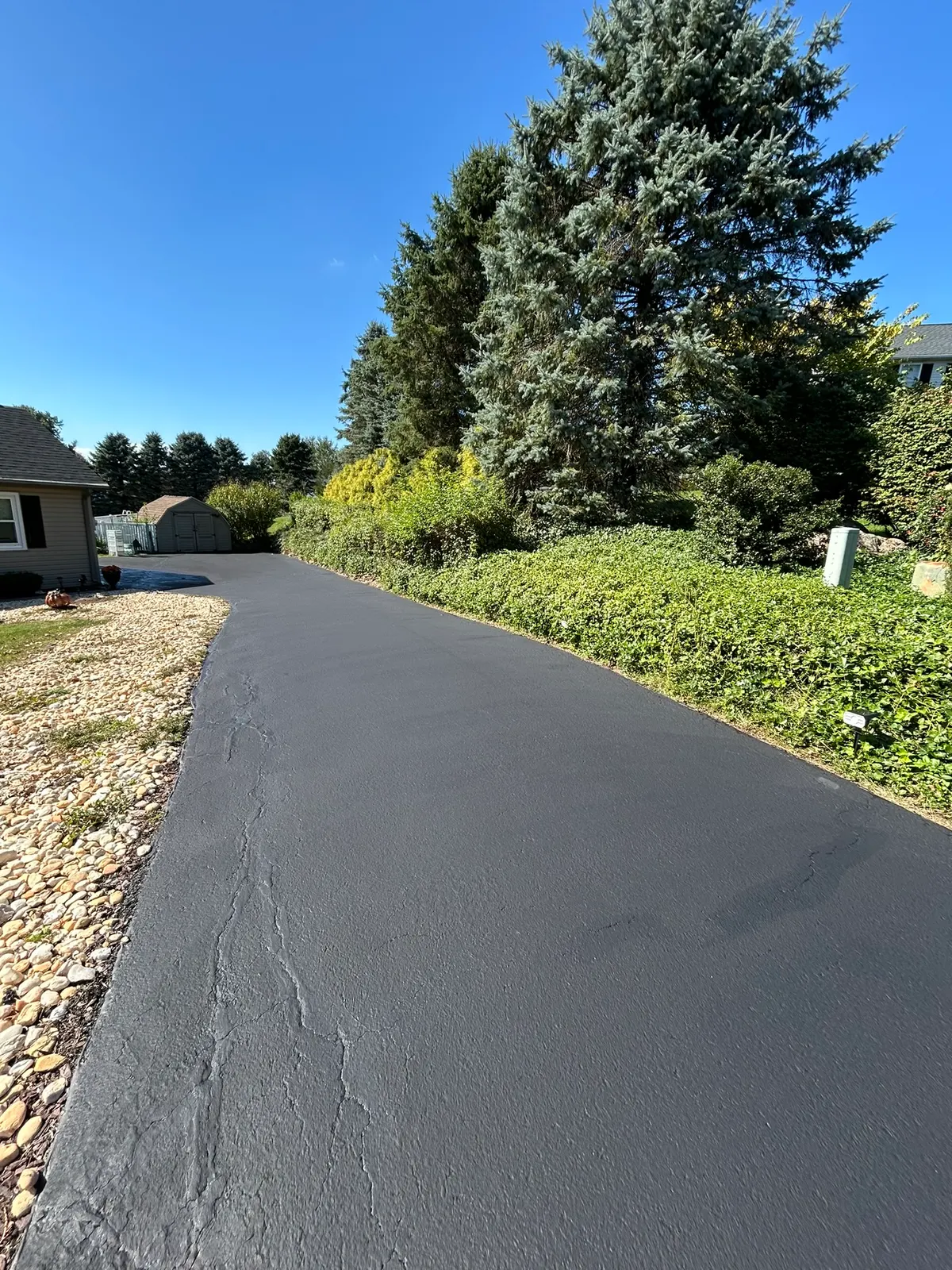
Crack repair comes first, then sealcoating. Sealer is a thin surface coat. Spread it over an open crack and the crack reappears within weeks, now with a black outline. Fill the cracks, let the material cure, then seal. A driveway done in that order looks uniform and is protected everywhere.
Mistakes we see all the time
- Filling over weeds and dirt. The filler pops out in the first freeze.
- Overfilling into a hump. Plows and tires catch it and rip it out.
- Sealing over open cracks. Looks fine for a month.
- Ignoring the edges. Edge cracks turn into a crumbling driveway edge.
- Waiting. A crack that would have taken minutes to seal in fall becomes a pothole by April.
Driveway cracks vs parking lot cracks
The same rules apply to a parking lot, with a few differences worth knowing if you manage commercial property.
Traffic is heavier and turns are tighter. Delivery trucks and cars turning into stalls put more stress on crack edges than a car pulling into a garage. Cracks in drive aisles and at entrances widen faster than cracks at the back of the lot.
Water has more places to go. A big lot collects a lot of rain. Cracks near drains, low spots and the bottom of slopes see the most water and need attention first.
The order of work matters more. On a lot that will also be sealcoated and re-striped, cracks go first, then sealer, then paint. Sealing cracks after the lines are fresh means working around new paint.
Downtime is a cost. Hot pour sealant cures quickly, so cracks can be sealed in sections while the rest of the lot stays open. That is one more reason hot pour is the standard on commercial lots.
Frequently asked questions
Can I just sealcoat over cracks?
No. Sealer does not fill cracks. Fill them first.
How long does a crack repair last?
Hot pour rubberized sealant, properly applied in a clean, dry crack, lasts several winters. Cold pour fillers usually need redoing sooner.
Will the repaired cracks be visible?
Yes, as smooth black lines, until the driveway is sealcoated. Even then, filled cracks show faintly under the sealer.
Do new cracks mean the driveway needs replacing?
Usually not. Cracks are normal aging. Replacement only becomes the conversation when the base has failed across large areas.
What is the difference between crack filling and crack sealing?
People use the terms interchangeably. Strictly, sealing is for cracks that move with temperature and uses a flexible material. Hot pour rubber does both jobs on driveways.
Need cracks sealed before winter?
Lancaster Lines & Asphalt seals driveway and parking lot cracks across Lancaster County with hot pour rubberized sealant. We clean every crack, fill it from the bottom up and finish it flush. See our crack filling and sealing page or request a free quote.