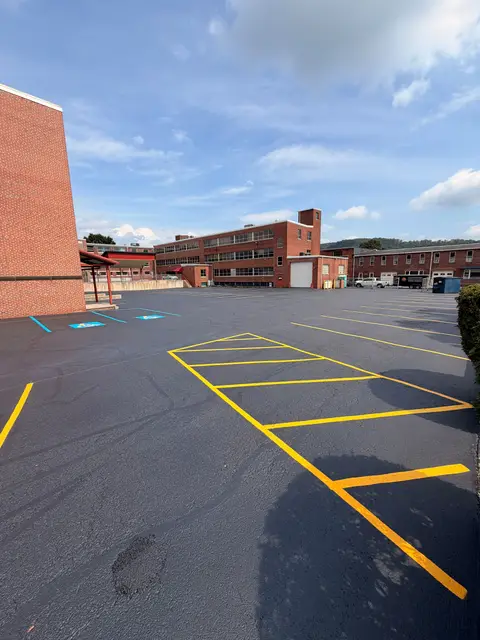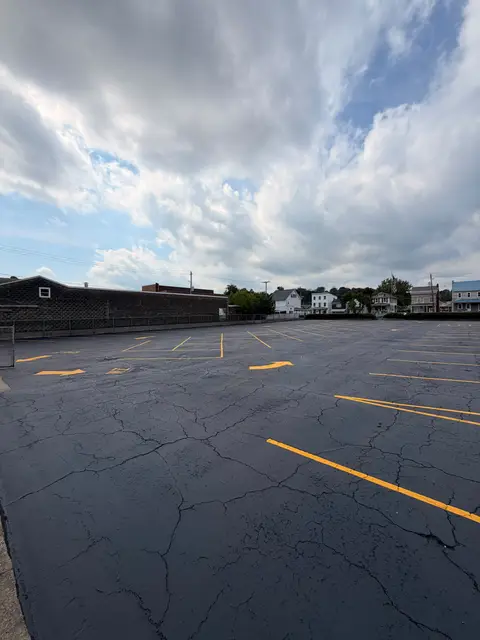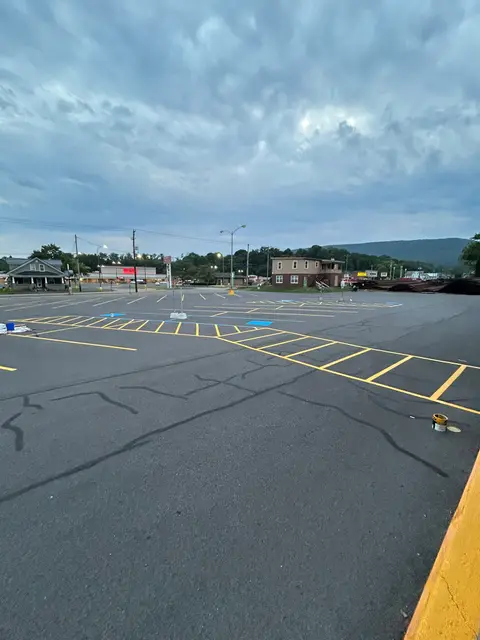

Older buildings often come with older parking lots. The building in this project is a multi-story brick structure, the kind you see at schools, offices and community buildings built decades ago, with a parking lot behind it that has clearly been through many Pennsylvania winters. The asphalt is weathered and cracked. The lines had faded to the point where the lot no longer told anyone where to park.
The job was a re-stripe: yellow stall lines across the lot, a yellow hatched aisle, and an accessible stall painted in blue with blue outline lines and the symbol of access. The photos show the finished lot.

Why re-stripe a lot that is not new?
It is fair to ask why fresh paint goes on asphalt that is cracked and gray. The answer is that the lines and the pavement are separate problems with separate budgets and separate timelines.
The pavement may need crack sealing, patching or eventually a larger repair. That can be planned over a few years. The lines are needed now. Without them, the lot holds fewer cars, people park at angles, the drive aisle gets blocked, and the accessible stall disappears. Painting the lines on an older lot restores order immediately, at a fraction of the cost of pavement work.
There is one condition: the surface has to be sound enough to hold paint. Cracks are fine. Loose, crumbling asphalt is not, because the paint comes off with the stones. On this lot the surface was weathered but solid.
What was painted
Yellow stall lines
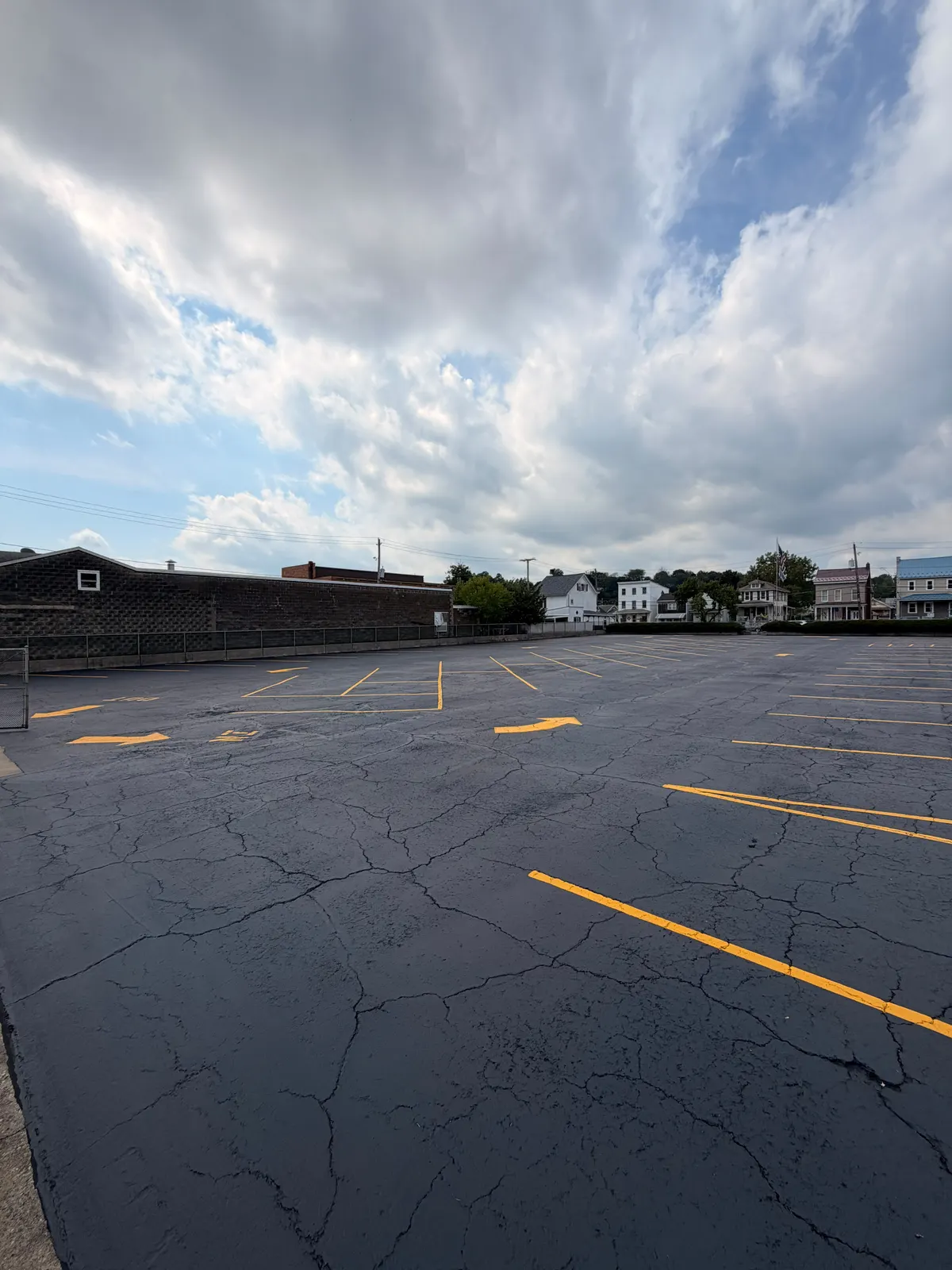
The stalls are painted in yellow. Yellow is very common on private lots in Pennsylvania and shows up well on gray, weathered asphalt, where white can look washed out. The lines run straight and at consistent widths, so each row reads clearly from the drive aisle.
A yellow hatched aisle
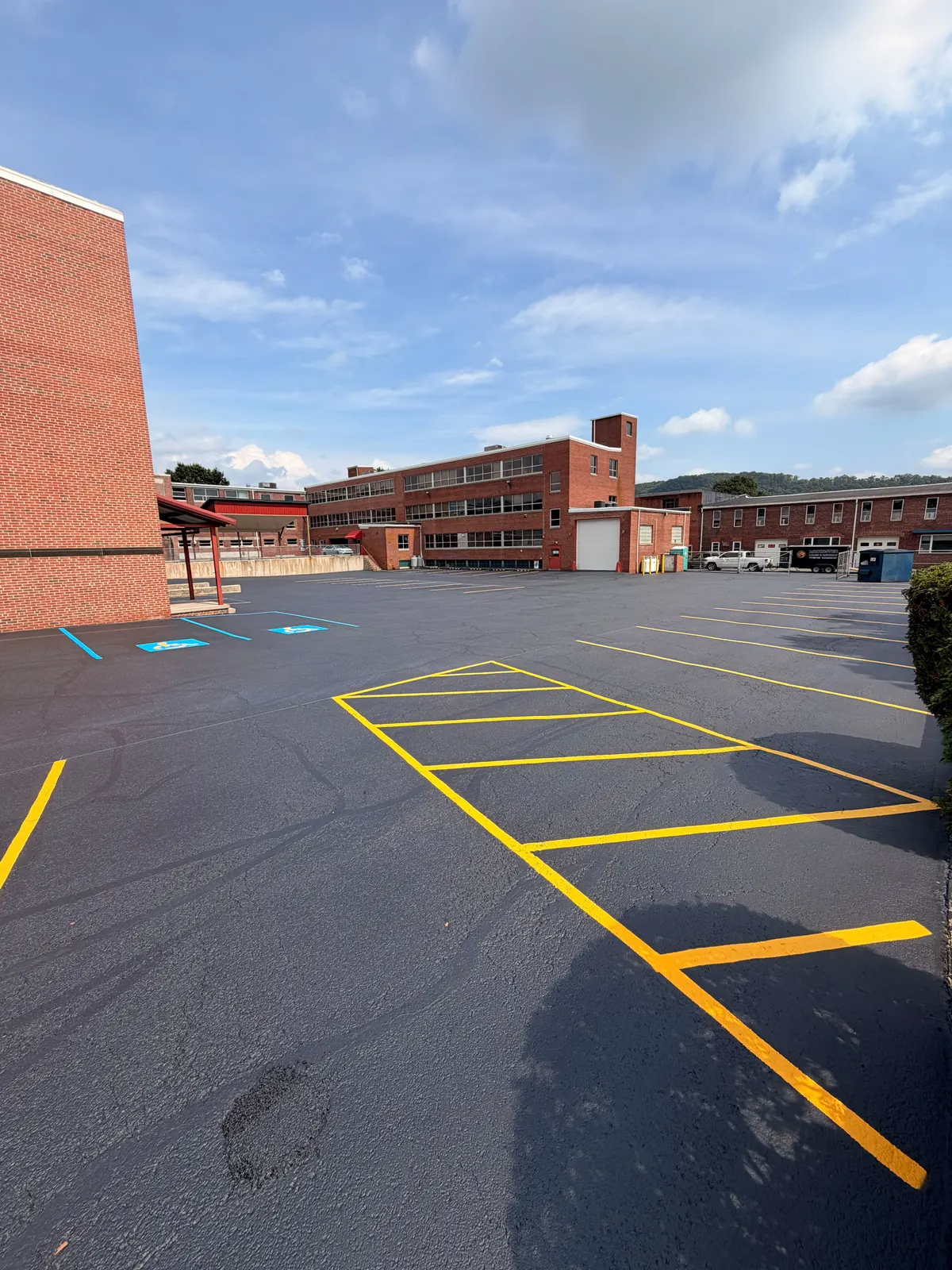
Next to the building, a hatched area in yellow marks space that must be kept clear. Hatched zones like this are used for access aisles, walkways from the lot to a door, and areas in front of entrances and utilities. The diagonals are evenly spaced inside a square outline, laid out with chalk before painting.
A blue ADA stall
The accessible stall is the most important marking on the lot. It is painted with the white and blue symbol of access centered in the stall, blue outline lines that set it apart from the yellow stalls around it, and an access aisle beside it.
Using blue for the outline of the accessible stall is a common choice and a practical one: a driver scanning the lot sees the blue stall immediately, and nobody mistakes it for a regular space. Whatever the color, three things matter more than paint:
- Enough accessible stalls for the total number of stalls in the lot.
- Correct dimensions for the stall and the access aisle, including at least one van accessible stall when required.
- The right location, on the shortest accessible route to an accessible entrance.
We check all three before painting. On an older property, the accessible entrance is not always the main door, so the stall has to go where the accessible route actually is. Our guide to ADA parking requirements in Pennsylvania explains each rule.
Working on an older surface
Striping weathered asphalt takes a little more care than striping a freshly sealed lot.
Cleaning. Older lots collect sand, grit and debris in the surface. The line paths are blown clean so the paint bonds to asphalt, not dust.
Cracks. Lines that cross cracks are painted right over them. The paint will not fix the crack, and a wide crack will eventually show through the line, but the line stays readable.
Old lines. Faded old lines are followed where the layout is right. Where the layout changes, the old lines are painted out so drivers do not follow ghost markings.
Contrast. On a gray surface, yellow and blue give strong contrast. That is part of why the color scheme works here.
What this lot needs next
The photos also show what is coming. The asphalt in the open part of the lot has a network of cracks, the kind that let water into the base every winter. The next step for a lot like this is a plan:
- Seal the cracks with hot pour rubber before the next winter, to keep water out of the base. See our guide to driveway and lot crack repair.
- Repair any failed spots before they turn into potholes.
- Sealcoat once the cracks and repairs are done, if the surface is still sound.
- Re-stripe on the cured sealer, at which point the lines go down on a clean black surface and look their best.
Doing it in that order means each step protects the next. If the budget does not cover everything in one year, crack sealing is the step with the biggest payoff, and the lines can be refreshed after the sealcoat.
Lessons for owners of older properties
- Lines are cheap compared to pavement. If your lot looks chaotic, re-striping is the fastest fix.
- The accessible stall comes first. On an older lot, faded ADA markings are the biggest risk. Paint them clearly and make sure they are in the right place.
- Use contrast. On weathered asphalt, yellow and blue read better than white.
- Plan the pavement work. Fresh lines buy time. Use that time to schedule crack sealing before the next winter.
- Expect to repaint after sealcoating. That is normal and planned for.
Questions owners ask about jobs like this
Is it worth striping a lot that will be sealcoated later?
Often yes, if the lot needs lines now and the sealcoat is a year or more away. The lines will need to be painted again after the sealcoat, which is part of the plan.
Can you paint over cracks?
Yes. The paint covers the crack and the line stays readable. Wide cracks should be sealed first if the work can be done in the same visit.
Why blue lines around the ADA stall?
Blue makes the accessible stall stand out from the regular stalls. The symbol, the size and the access aisle are what make it compliant; the blue outline makes it easy to see.
Do you black out old lines?
Yes, when the layout changes, so the old lines do not confuse drivers.
Can you check whether our ADA stalls meet the standard?
Yes. We count the stalls, measure the accessible stalls and aisles, and look at the route to the entrance before we paint.
How we approach a lot like this, start to finish
For anyone curious what the day of a job like this looks like, here is the sequence.
Walk and measure. Before anything else, we walk the lot with the person responsible for it. We look at the existing lines, count the stalls, find the accessible entrance, and measure the accessible stall and aisle. On an older property, this is also when we note the cracks, the low spots and anything that will affect the paint.
Agree the layout. If the old layout works, we follow it. If something needs to change, for example the accessible stall is in the wrong place or the hatching is missing, we mark the change and confirm it before painting.
Clean the line paths. Every line, hatch and symbol location is blown clean of sand and debris.
Chalk and paint. The hatched areas and any new lines are snapped with chalk. Stall lines go down with the striping machine. Symbols and stencils are placed by hand.
Cone and dry. The painted area stays coned until the paint is dry, usually within the hour on a warm, dry day.
Walk it again. We walk the finished lot to check line widths, ends, the symbol placement and the aisle hatching before we leave.
Why the color choice was right for this lot
Some owners ask whether they should switch from yellow to white when they re-stripe. On a lot like this one, staying with yellow was the right call. The asphalt is weathered and light gray, and white lines on light gray asphalt lose contrast quickly, especially when the paint starts to wear. Yellow keeps reading clearly even on an older surface. When the lot is eventually sealcoated to a deep black, either color will look sharp, and that is a good moment to decide whether to switch.
Details
- Parking lot behind an older multi-story brick building.
- Yellow stall lines and a yellow hatched aisle laid out with chalk and painted with a striping machine.
- Accessible stall painted with the symbol of access, blue outline lines and an access aisle.
- Weathered, cracked asphalt; crack sealing and sealcoating recommended as the next steps.
Lancaster Lines & Asphalt re-stripes lots of every age across Lancaster County and the surrounding area, and keeps accessible stalls to the current standard. See the parking lot striping and line painting page or request a free quote.