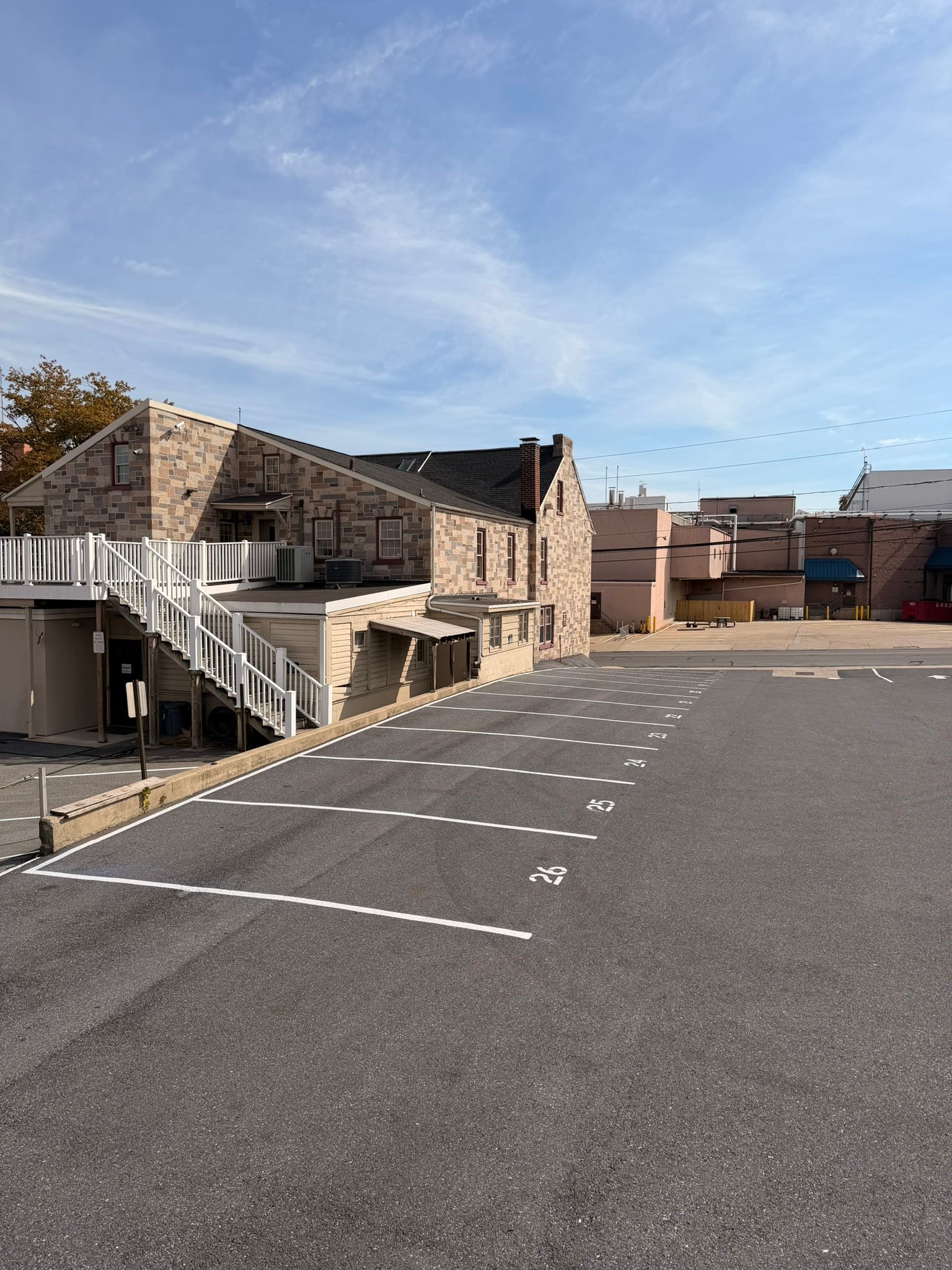

Most clients call us about faded lines. But when we walked this lot, fading was only part of the story. The asphalt was sound, the layout was already established — but the lines had reached the end of their useful life after two hard Pennsylvania winters, and the numbered stall system had almost completely disappeared.
This post is a full walkthrough of what we did, why we made the material and layout decisions we made, and what property owners in Lancaster County should understand before scheduling any re-stripe job — regardless of who does it.
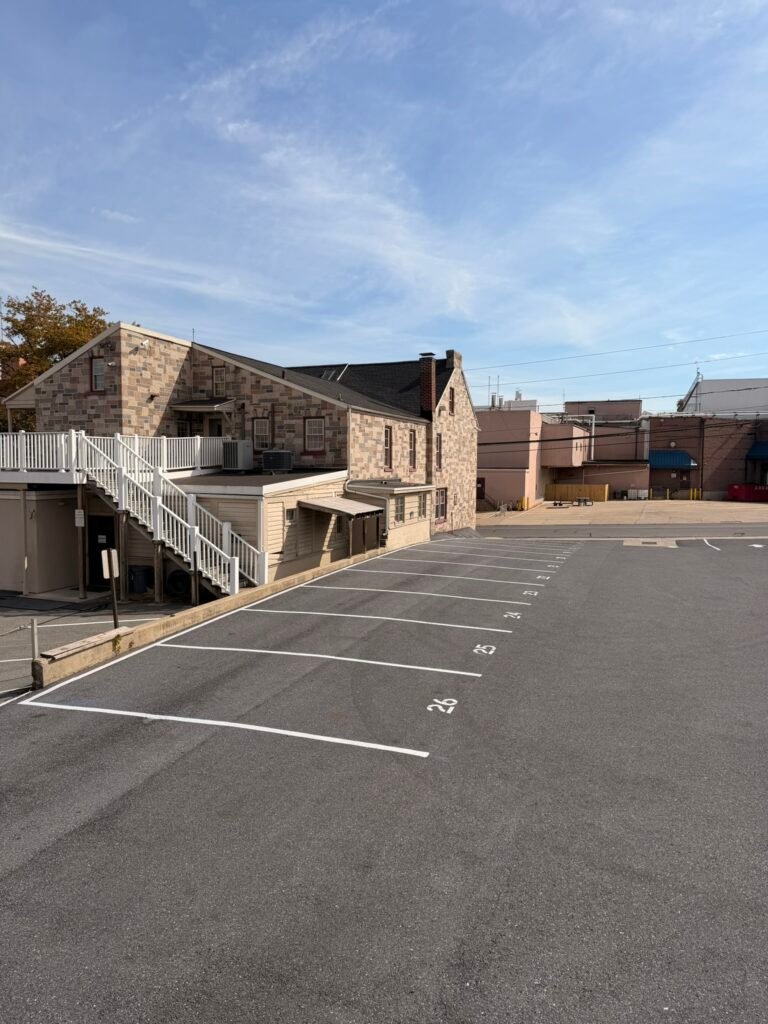
It’s a real project. The photo above is the finished result.
What the Job Actually Involved
The lot serves a mixed-use commercial property in Lancaster — a stone building with a staircase deck and street-level entry, surrounded by additional commercial structures. The lot handles regular daily traffic from tenants and visitors, with parking organized in a single-direction configuration along the building face.
| Location | Lancaster, PA (downtown adjacent) |
| Total stalls | 26 numbered spaces |
| Configuration | Angled + parallel, single-direction flow |
| Surface condition | Good — no structural cracking, minor surface oxidation |
| Existing lines | Severely faded; numbers illegible |
| Paint spec | 4-inch white waterborne traffic paint |
| Completion time | Half day (prep + application + cure) |
| Season | Fall 2025 — above 55°F, dry conditions |
The numbered stall system was the client’s requirement — they manage assigned parking for tenants and needed numbered spaces for enforcement. This adds a layer of precision to the layout: stencil placement, number size, and positioning all have to be consistent across all 26 stalls, or the lot looks sloppy even with clean lines.
Surface Preparation: The Part That Determines How Long It Lasts
The surface was in good structural condition — no major cracking, no heaving, no potholes. But “good condition” doesn’t mean “ready to stripe.” Before we touched the sprayer, we ran through our standard pre-application checklist.
The lot had the typical post-winter residue: embedded sand from deicing operations, a light dust layer, and a few oil stains near the entry area. We blew out the entire surface with compressed air first — not a leaf blower pass, but a thorough push that gets sand out of the asphalt texture. That texture is what the paint bonds to. If you paint over dust, you’re not painting the asphalt — you’re painting the dust, and it peels within weeks.
The oil spots near the entry received a shellac-based spot primer before we striped. Oil contamination is hydrophobic — water-based paint won’t adhere to it. This step costs ten minutes and prevents a delamination failure in that zone within the first season.
Our field rule: Surface temperature must be at least 5°F above the dew point before we spray. We check with an infrared thermometer on every job. On days where the spread is too narrow, we wait — even if it costs scheduling time. Paint applied near the dew point traps moisture under the film and fails early. No exceptions.
We also measured surface temperature: asphalt in direct sun can exceed 120°F in summer. At that temperature, waterborne paint flashes too quickly, creating dry spray and poor adhesion. For this job in fall conditions, surface temperature was in the ideal 60–75°F range. No adjustments needed.
Layout: Why We Don’t Wing It
Re-striping over clearly visible existing lines is straightforward. This job wasn’t that. The existing lines had faded to near-invisible, which meant we were essentially doing a fresh layout — using the ghost lines as a reference but not relying on them as a guide.
We snapped chalk reference lines along the entire bay length before touching the sprayer. Every stall was measured individually — 8.5 feet wide, 18 feet deep for the angled spaces, with consistent 4-inch line width throughout. The numbered stall approach means that if stall 14 is 6 inches narrower than stall 15, the tenant assigned to stall 14 will notice. Consistency isn’t cosmetic — it’s functional.
The stall numbers were applied with 12-inch stencils, centered at the rear of each stall. We position numbers at the back rather than the front for a reason: drivers pulling in read numbers before they commit to the space, not after. Front-positioned numbers get worn first by front tires and are less visible during approach.
A proper layout takes longer than spraying. On a 26-stall lot, we spend roughly 40% of the total job time on prep and measurement. That’s what separates a stripe job that looks right in week one and a stripe job that still looks right in year three.— Lancaster Lines & Asphalt field notes
Why We Used Waterborne Traffic Paint — Not “Parking Lot Paint”
This is the spec question we get most often from property owners who’ve been burned before. The short answer: there is a significant difference between DOT-specification waterborne traffic paint and the generic “parking lot paint” sold at hardware stores. The difference isn’t primarily color — it’s binder solids content, glass bead loading, and dry film thickness.
The paint we use on commercial jobs contains glass microspheres mixed into the formula. Under headlights at night or in rain, those beads create retroreflectivity — light bounces back toward the driver rather than scattering. The FHWA’s MUTCD 2023 edition establishes minimum maintained retroreflectivity standards for pavement markings. Generic hardware store paint contains no glass beads and meets none of those standards.
Dry film thickness on this job: 7 mils after curing (applied at 15 mils wet). That’s the minimum we accept on commercial surfaces with regular vehicle traffic. Below 5 mils dry, lines on a busy lot won’t survive a Lancaster winter. We verify wet film thickness with a gauge during application — not by eye.
Why this matters for your property
If a contractor can’t tell you the dry film thickness specification for the paint they’re applying, that’s a red flag. On a commercial lot, the difference between 5-mil and 9-mil application is roughly the difference between 18 months and 4 years of service life — on the same product, from the same bucket.
For the numbered stall system specifically, paint build matters even more. Numbers applied at low mil thickness wear through in the high-traffic rear-of-stall zone within one season. We applied a second pass on all 26 number stencils to ensure adequate coverage in the most wear-prone areas.
For deeper background on what goes into a re-stripe decision, see our post on how often parking lots need re-striping — including the specific signs that indicate it’s time versus just cosmetically desirable.
ADA Compliance on This Lot
This particular lot does not have designated accessible spaces in the re-striped section shown in the photo. The accessible parking for this property is located at a separate entrance with direct building access — a layout decision that predates our involvement and is consistent with ADA 2010 Section 208, which requires accessible spaces to be on the shortest accessible route to an accessible building entrance, not simply placed in the largest lot section.
We point this out because it’s a common misunderstanding: accessible spaces don’t have to be in every section of a multi-section lot. They have to be correctly located relative to accessible building entrances. Placing an ADA space in the “main” lot while the accessible entrance is on the opposite side of the building is a violation even if the space dimensions and markings are perfect.
If you’re unsure whether your accessible parking layout is compliant, our post on ADA parking lot requirements for business owners covers the placement rules, required counts by lot size, and the signage requirements that painted symbols alone don’t satisfy.
What a Properly Striped Lot Actually Does For a Property
Looking at the finished photo: clean lines, readable numbers, consistent 4-inch width, sharp edges with no overspray onto the adjacent concrete. The lot holds 26 spaces in what was previously a disorganized-looking surface. The numbered system lets the property manager assign and enforce tenant parking without ambiguity.
But beyond aesthetics, there’s a practical safety and liability dimension that property owners often undervalue. Faded or missing lines increase parking conflicts, create ambiguous pedestrian paths, and — in the event of an incident on the property — become part of any negligence analysis. A lot that demonstrably meets traffic marking standards is a lot with a documented maintenance record.
For commercial properties specifically, we always recommend documenting the re-stripe date, paint specification, and contractor information. Keep it with your property maintenance records. If a slip-and-fall or vehicle incident occurs in the parking area, that documentation establishes that you maintained the lot to professional standards.
Spring is the right time to address winter-damaged markings before your busiest season. Our spring asphalt maintenance checklist covers the full sequence — from surface assessment through sealcoating timing to striping — so you’re not making reactive decisions when the lot is already showing problems.