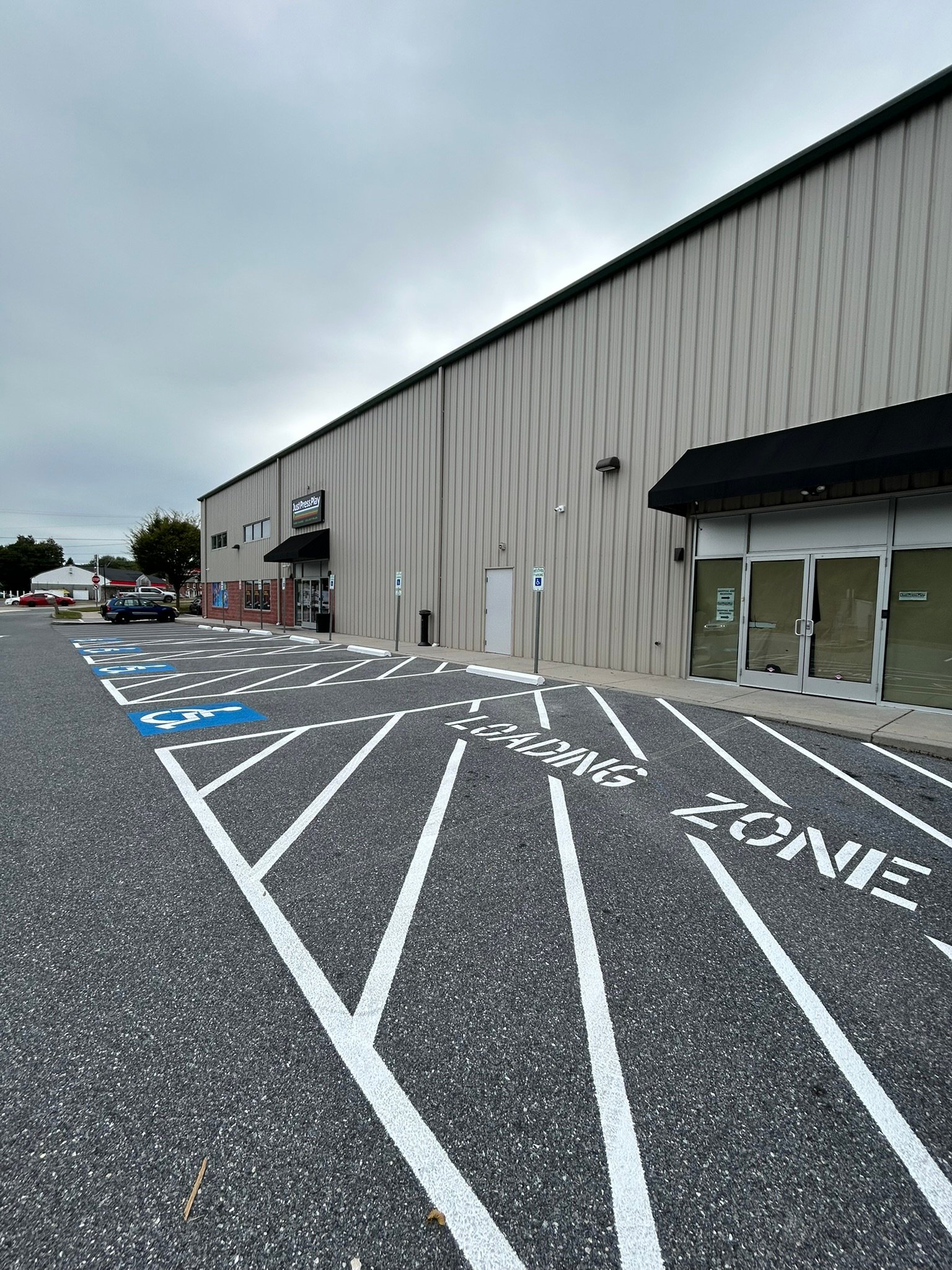

When a commercial property needs new striping, most property managers think about stall lines — how many spaces, how wide, which direction. But what the photo above shows is the harder part of the job: ADA-compliant accessible spaces and a correctly configured loading zone, executed together on a freshly paved lot for a retail building in Lancaster County.
These two marking types — accessible parking and loading zones — are the most frequently cited violations in DOT and ADA compliance inspections for commercial properties across Pennsylvania. Getting them wrong isn’t a cosmetic issue. It’s a legal one.
In this post we walk through what this job required, what the standards actually say, and what any business owner or property manager in Lancaster County should verify before their next striping project.
Project Overview
This was a complete new layout on a freshly sealed commercial lot serving a large-format retail building. The client needed the full package: standard parking stalls, ADA-compliant accessible spaces with access aisles, a designated loading zone adjacent to the main entrance, and clean sight lines throughout.
| Property type | Commercial retail — large-format metal building with storefront entry |
| Location | Lancaster County, PA |
| Scope | Full new layout — ADA spaces, loading zone, standard stalls |
| ADA spaces | 2 accessible spaces + 1 van-accessible, with hatched access aisles |
| Loading zone | Diagonal hatched zone with “LOADING ZONE” stencil, positioned adjacent to main entrance |
| Surface | Fresh asphalt — 60-day cure before application |
| Paint | White waterborne traffic paint (4-inch lines) + blue DOT-spec paint for ISA symbols |
| Completion | Single day — layout, application, cure |
The building shows a fitness/retail tenant (visible signage) with a direct front entry and a secondary door — both requiring accessible path connectivity from the striped spaces. That path connectivity is part of what we verify before finalizing ADA space placement.

The ADA Spaces: What the Standards Actually Require
Look at the left side of the photo: two standard accessible spaces plus one van-accessible, each with the characteristic hatched access aisle on the right side. This isn’t decorative — every element of that layout is federally specified under ADA 2010 Standards for Accessible Design, Section 502.
Here’s what a compliant accessible parking space actually requires — and where most non-compliant lots fail:
| Requirement | Standard Accessible | Van-Accessible |
|---|---|---|
| Space width | Minimum 8 ft (96 inches) | Minimum 11 ft — OR 8 ft with 8 ft aisle |
| Access aisle width | Minimum 5 ft (60 inches) | Minimum 8 ft (96 inches) |
| Surface slope | Maximum 1:48 (2.08%) in any direction — space AND aisle | |
| ISA symbol | Required on pavement surface, centered in space | |
| Signage | Vertical sign minimum 60″ to bottom, at head of space — paint alone is NOT compliant | |
| Route connection | Must connect to accessible route to accessible entrance — no curb steps, no steep cross-slopes | |
| Location | Shortest accessible route to accessible building entrance | |
The most common compliance failure we see in Lancaster County: accessible spaces placed in the “most convenient looking” spot — not on the shortest accessible route to the accessible entrance. On a multi-entrance building, this distinction matters. The ADA doesn’t care which entrance is biggest or most prominent. It cares about which entrance is accessible, and the spaces must connect to that one specifically.
On this project, the spaces are positioned directly in front of the main entrance — which is the accessible entrance, confirmed by the automatic door hardware visible in the photo. The hatched aisles are on the building side, so exiting occupants move from vehicle to curb cut without crossing any travel lane. That’s correct placement. We measured the surface slope in four directions across each space before finalizing layout. This lot passed at well under 1% — unusually good for a new pour.
For a complete breakdown of ADA space count requirements and signage rules, see our post on ADA parking lot requirements for Lancaster County business owners.

The Loading Zone: More Technical Than It Looks
The diagonal hatched zone with “LOADING ZONE” stenciling in the center of the photo is one of the most misunderstood markings in commercial parking. Property managers often think of it as simply a “no parking” area. It’s not. A properly configured loading zone is a designated functional space with its own geometry, visibility requirements, and — on some commercial properties — local fire code implications.
Why diagonal hatching?
The diagonal lines (not parallel to stall lines) serve a specific visual purpose: they signal to drivers that this is a functional area, not a missed parking space. The MUTCD recommends diagonal hatching at 45° for non-parking areas that are part of the circulation pattern. Single-direction hatching is intentional — drivers read it instantly as “this is not a stall.”
The zone dimensions on this project were set to accommodate delivery vehicles — a standard 10 ft × 20 ft minimum footprint, positioned with direct access to the secondary entry door. The “LOADING ZONE” stencil uses 18-inch block lettering, readable from the end of the aisle on approach. Undersized lettering on loading zone stencils is one of the most common quality failures we fix on re-stripe jobs — 12-inch letters read fine in photos but disappear at distance on an active lot.
Relationship to ADA access aisles
One placement rule that few contractors check: a loading zone cannot encroach on an ADA access aisle, and cannot block the accessible route from the accessible spaces to the building entrance. On this layout, the loading zone is positioned to the right of the accessible spaces, with clear separation. A vehicle parked in the loading zone — even a large delivery truck — cannot block the path from either accessible space to the front door.
Loading zones and accessible spaces are often designed in isolation and then dropped into a lot without checking their interaction. We always lay out ADA spaces first, establish the accessible route, and then fit the loading zone into what remains — never the other way around.— Lancaster Lines & Asphalt field practice
Paint Specification on a Fresh Asphalt Surface
Fresh asphalt requires a minimum cure period before striping. The industry standard — and our firm rule — is 30 days minimum for waterborne traffic paint, and 90 days if thermoplastic is specified. Apply too early and the volatile oils still off-gassing from new asphalt contaminate the paint-asphalt bond. The paint may look fine for 60 days and then begin peeling in sheets.
This lot was cured 60 days before we applied. Surface temperature on the day of application: 68°F, with dew point 14°F below surface — ideal bonding conditions. We applied DOT-specification waterborne traffic paint at 15 mils wet film, targeting 7–8 mils dry after cure. All ISA symbols received a second pass to build coverage in the wear-prone center zones.
The blue paint for ISA symbols is a separate specification from white traffic paint. We use DOT-spec blue formulated to match Federal Highway Administration color standards — not generic blue spray paint, which fades to gray within a single season in Pennsylvania UV conditions. The contrast between the blue field and white border of a properly painted ISA symbol is what gives it ADA-compliant visibility at distance.
On surface condition and paint life
The single biggest factor in how long striping lasts is not paint brand — it’s surface condition at time of application. Properly cured asphalt, correct surface temperature, dew point clearance, and clean dry substrate will outperform premium paint on a compromised surface every time. A stripe job done right on a well-prepared lot should deliver 3–5 years of service before re-stripe is needed under normal commercial traffic.
For more on how asphalt surface condition affects striping longevity — and what to address before re-striping — see our spring asphalt checklist, which covers the inspection sequence from surface assessment through sealcoating and striping decisions.
What This Means for Your Property
If you manage or own a commercial property in Lancaster County — a retail strip, a fitness facility, a medical office, a warehouse with customer access — the combination of accessible parking and a loading zone is one of the highest-risk areas for compliance violations and liability exposure.
Most violations aren’t intentional. They happen because:
- The original striping was done without measuring slopes (ADA requires ≤ 2.08% — many lots fail this silently)
- Signage was never installed or was replaced incorrectly (paint alone is not ADA-compliant)
- A re-stripe shifted space dimensions slightly and nobody checked van-accessible aisle width
- The loading zone blocks the accessible route after a layout change
A DOT or ADA compliance inspection can result in a formal Corrective Action notice, and unlike most building code violations, ADA complaints have no statute of limitations — a violation that’s been in place for 10 years can still be cited today. The re-stripe cost to correct it is minor compared to the liability if an incident occurs on a documented non-compliant lot.
We offer free on-site compliance assessments for Lancaster County commercial properties — we walk the lot, measure slopes, check aisle widths, and document what’s compliant and what isn’t, before you commit to any striping scope. See our detailed guide on when and why parking lots need re-striping for the full evaluation framework.
We Do This Work Across All of Lancaster County — and Beyond
This project is one example of the commercial ADA and loading zone striping we complete regularly throughout Lancaster County and surrounding areas. Property managers in Ephrata dealing with compliance notices, fitness centers in Lititz expanding their lots, warehouses in Manheim adding loading access, medical offices in Mount Joy needing van-accessible spaces — these are exactly the calls we respond to every week.
We work within 35 miles of Lancaster city, which means we cover most of south-central Pennsylvania’s commercial corridor. If you’re a property owner or manager anywhere in the following areas, we can typically provide a same-week site visit and a 24-hour quote turnaround:
Lancaster, PA Ephrata, PA Lititz, PA Manheim, PA Mount Joy, PA Elizabethtown, PA Columbia, PA
Marietta, PA Millersville, PA New Holland, PA Quarryville, PA Leola, PA Denver, PA Akron, PA
Strasburg, PA East Petersburg Manheim Twp Willow Street Landisville, PA Lebanon, PA
York, PA Reading, PA
Commercial properties in York and Reading are within our standard service range. If your property is outside these listed areas, call us — we routinely take jobs beyond the list above for the right project scope.