
Small lots get overlooked. A business with eight or ten spaces behind the building rarely thinks of its lot as something that needs a maintenance plan. But a small lot is often the first thing a customer sees, and on a tight lot every stall and every arrow counts. When the asphalt turns gray and the lines fade, a small lot looks neglected faster than a big one.
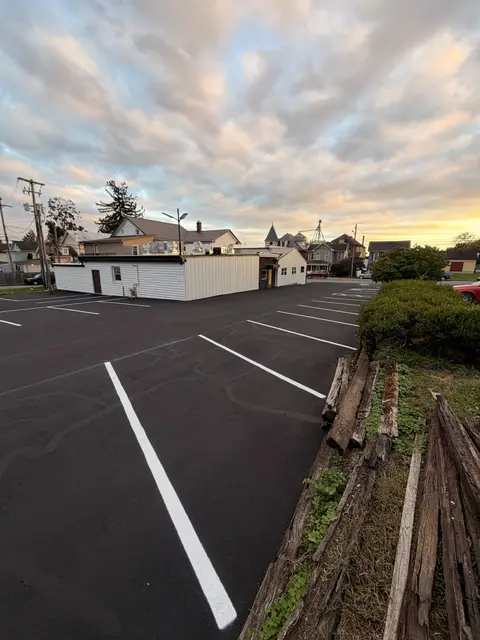
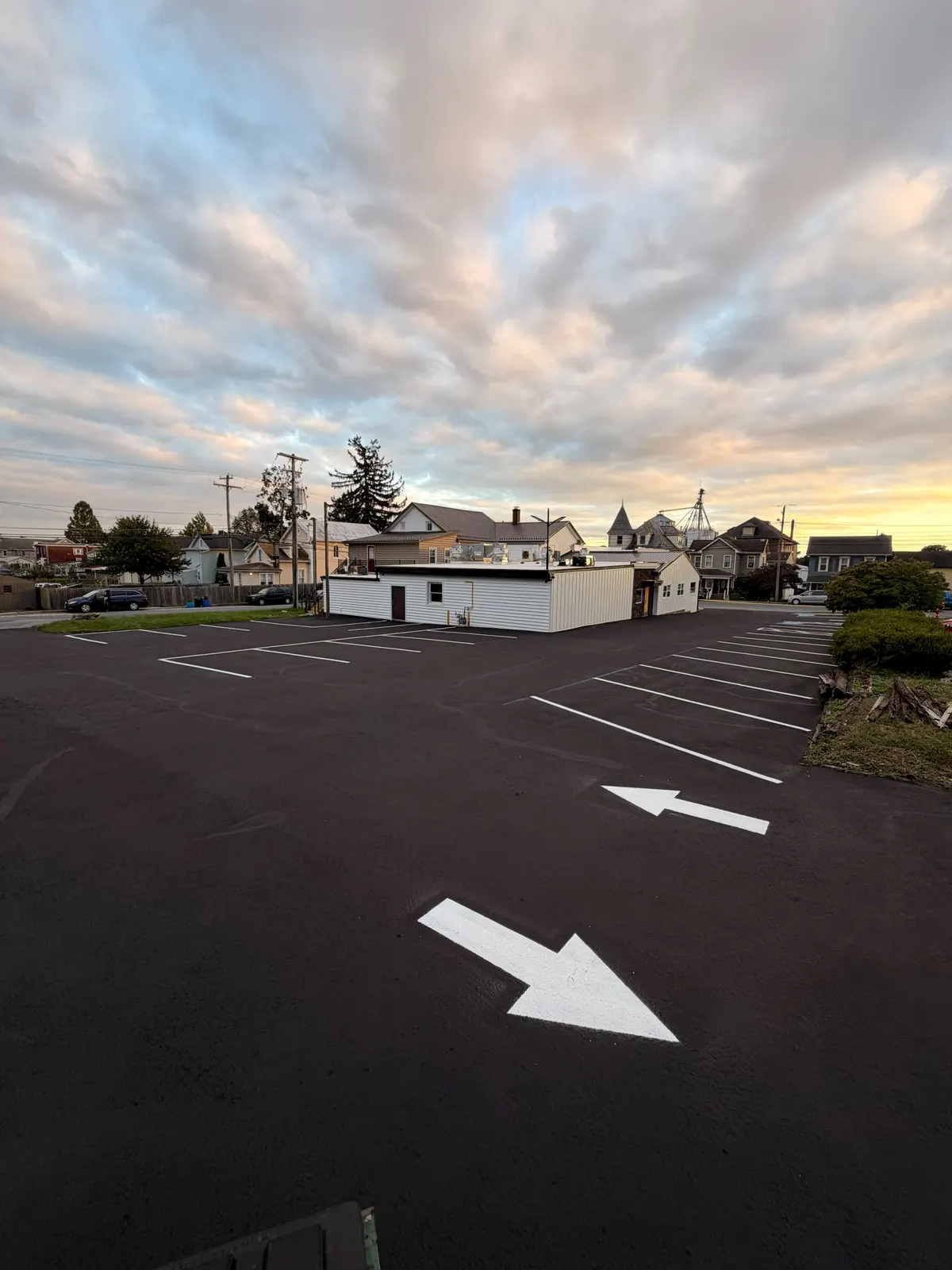
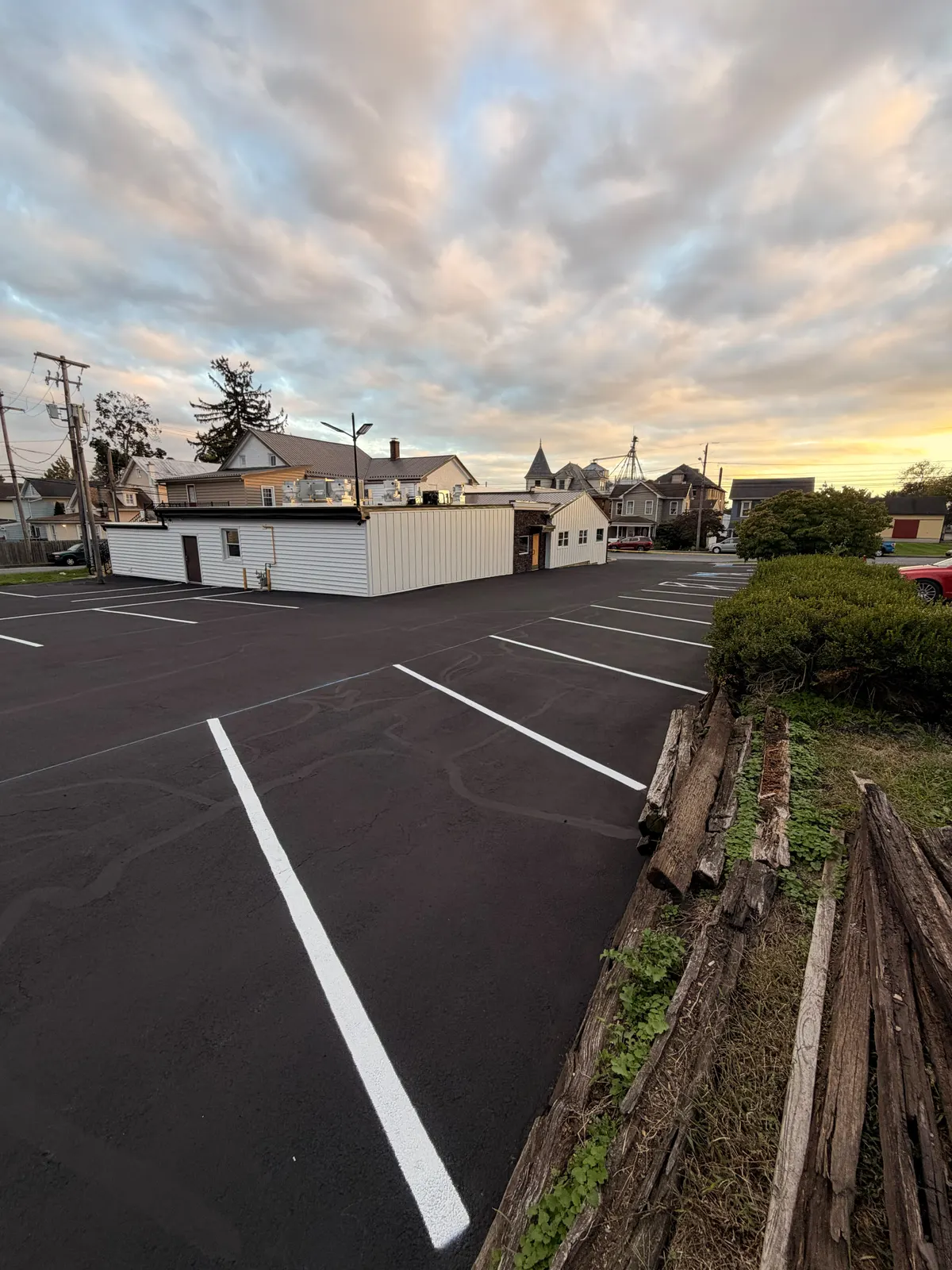
This project is a small commercial lot in a town setting, photographed at sunset just after the work was finished. It was sealcoated, then re-striped with white stall lines and directional arrows. The result is the look most owners want: a deep black surface with crisp white markings that read from the street.
Why seal first and stripe second
The single biggest reason this lot looks sharp is the order of work.
Sealcoat first. The sealer covers the whole surface in a uniform black coat, including the faded old lines. It protects the asphalt from sun, water, oil and salt, and it gives the paint a clean, even surface to sit on.
Let it cure. Sealer needs time, usually 24 to 48 hours depending on temperature and humidity, before it can be painted. Paint on uncured sealer can bleed and fail.
Stripe second. White traffic paint on fresh black sealer is the highest contrast combination there is. Lines, arrows and stencils look brighter and sharper than they ever do on gray asphalt.
Doing it the other way around wastes money. Lines painted before sealing get covered and have to be painted again. Sealer applied around existing lines leaves a patchy look. One plan, done in order, gets it right once. We cover the full sequence on our parking lot maintenance page.
What the sealcoat did
A sealcoat on a small lot is the same job as on a large one, just with more edge work per square foot.
- Cleaning. Dirt and debris blown off, edges scraped, and oil spots primed so the sealer bonds instead of peeling.
- Cracks. Any open cracks filled before sealing, because sealer alone does not fill them.
- Edges by hand. On a small lot, a large share of the work is along curbs, building walls, landscaping and the street. Those edges are cut in with a brush.
- Two coats. Two thin coats rather than one thick one, for even coverage that wears gradually instead of peeling.
The photos show the result: a uniform, deep black surface right up to the curbs and the landscaping.
If you are not sure whether your lot is ready for sealing, our guide to what sealcoating is and what it does explains the signs to look for.
What the striping did
White stall lines
The stalls are painted in white, laid out to the existing layout. On a small lot, consistency matters: stalls of the same width, lines of the same width, clean ends. A single crooked line on a lot of ten stalls is noticeable.
Directional arrows
The arrows show the flow through the lot. On a small lot with one way in and one way out, or a tight turnaround, arrows prevent the awkward standoff where two cars meet head on in a narrow aisle. Arrows are painted by hand with stencils and placed where drivers see them before they have to choose a direction.
What it does for a small business
For a small business, the lot is part of the storefront. A freshly sealed, freshly striped lot:
- Looks cared for, which customers notice even if they could not say why.
- Parks more cars, because people use the stalls instead of parking wherever.
- Moves traffic smoothly, because the arrows answer the question of which way to go.
- Lasts longer, because the sealer protects the asphalt from the things that break it down.
For a small lot, the cost of doing both in one plan is modest compared to what it does for first impressions.
Scheduling a small lot
Small lots have one advantage: the whole job can usually be planned around a quiet stretch. The sealcoat goes down when the business is closed or slow, the lot stays closed while the sealer cures, and the striping happens in a short visit once the surface is ready. For businesses that cannot close the lot for two days, the work can be split into sections, with part of the lot kept open while the other part is sealed and cured.
The thing that matters most on the day is that the lot is empty. A single car left overnight means a rectangle of unsealed asphalt. Our checklist for getting a property ready for sealcoating or striping day covers notices to staff and customers, sprinklers, deliveries and parking during the cure.
Keeping it looking like this
- Re-stripe every one to two years, or when you can no longer see the lines clearly from across the lot.
- Sealcoat every two to three years for a commercial lot with regular traffic.
- Fill cracks every fall before winter.
- Clean oil spots when they appear, before they soak in.
- Touch up arrows and stencils as needed; they wear faster than stall lines.
Lessons for other small lot owners
- Do it in order. Cracks, then sealer, then lines.
- Plan for the cure time. The lot has to stay empty while the sealer cures.
- Use white on fresh sealer for the sharpest look.
- Do not skip the arrows on a tight lot; they prevent most of the awkward moments.
- Small lots deserve the same care as big ones. The edges are where the difference shows.
Questions owners ask about jobs like this
How long is the lot closed?
The sealcoat needs to cure before cars drive on it, usually 24 to 48 hours depending on the weather. Striping adds a short visit after that, and the paint is typically dry within an hour.
Can you do both on the same day?
Not on the same surface. The sealer has to cure first. The striping happens on a later visit.
Do the old lines need to be removed?
Not when the lot is sealed. The sealer covers the faded old lines, and the new lines go down on the fresh surface.
Can we change the layout?
Yes. Sealcoating is the ideal time to change a layout, because the old lines disappear under the sealer.
Is a small lot worth sealing?
Yes. Sealing protects the asphalt and extends its life, and a small lot is often the most visible part of a small business.
What the edges tell you about a sealcoat
On a small lot, a large share of the surface is edge: along curbs, building walls, the street, landscaping, drains and utility covers. That makes edge work the best way to judge the job. Here is what to look for when the crew leaves:
- Sealer runs right up to the curb with no strip of gray asphalt left along it.
- No sealer on the curb face, the sidewalk or the building. A straight, clean line where asphalt meets concrete.
- Drains and covers are clean. Sealer should not be sprayed into a storm drain or over a manhole lid.
- Landscaping is untouched. Mulch beds and plants next to the lot should not be speckled black.
- No puddles of sealer in low spots near the edges.
On this lot, the photos show the black surface running cleanly to the curbs and the planted strip. That is hand work with a brush, and it is the part of a small lot job that takes the most time.
What we look at before sealing a small lot
Not every small lot is ready for sealer. Before a job like this, we walk the surface and check a few things.
- Is the asphalt sound? Sealer protects pavement that is still solid. Alligator cracking, soft spots or crumbling areas need repair first.
- Are there cracks wider than a hairline? Those get filled before sealing, or the cracks show right through the new coat.
- Where are the oil spots? On a small lot where the same cars park every day, the stalls by the door usually have oil stains that need priming.
- Where does the water go? Low spots near drains and curbs wear sealer faster and tell us something about the base.
- What has to stay clean? Sidewalks, building walls, landscaping and the street edge are all protected during the work.
Details
- Small commercial lot in a town setting.
- Sealcoated to a uniform black surface right up to the curbs and landscaping.
- Re-striped after the sealer cured, with white stall lines and directional arrows.
- Photographed at sunset just after completion.
Lancaster Lines & Asphalt seals and stripes lots of every size across Lancaster County and the surrounding area, small ones included. See the sealcoating page and the parking lot striping page, or request a free quote.