
The $75,000 Mistake You Walk Past Every Day
If you own or manage a commercial property in Lancaster, Ephrata, or York, PA, you likely walk past your parking lot every day without a second thought. You see asphalt, lines, and cars.
But when a professional ADA attorney or a serial plaintiff drives past your lot, they see something very different. They see a retirement fund.
The Americans with Disabilities Act (ADA) is arguably the most litigated federal law affecting property owners today. In Pennsylvania, which courts have historically deemed a “plaintiff-friendly” environment for accessibility lawsuits, the margin for error is zero.
Many business owners believe that “grandfather clauses” protect them. This is a dangerous myth. ADA compliance is an ongoing obligation. A faded line, a bent sign, or a pothole in a handicap spot isn’t just a maintenance issue – it is a civil rights violation.
The Department of Justice (DOJ) can levy civil penalties of up to $75,000 for your first violation and $150,000 for subsequent violations. And that doesn’t include the private lawsuits, legal fees, and settlement costs that often follow.
At Lancaster Lines & Asphalt, we don’t just paint lines; we protect your assets. We have audited hundreds of lots across Pennsylvania, and we find compliant lots to be the exception, not the rule.
This comprehensive guide is your insurance policy. We will cover everything from the 2010 Federal Standards to specific Pennsylvania Vehicle Code requirements, the technical science of asphalt leveling, and how to prepare for the upcoming 2026 building code changes.
The “Magic Numbers” – Ratios and Dimensions
Compliance starts with math. Before a drop of paint touches the ground, we must calculate the required number of spaces based on your facility’s capacity.
1.1 How Many Spots Do You Really Need?
The number of required accessible spaces is a sliding scale based on the total number of parking spaces in a facility (lot or garage).
Note: Medical facilities have stricter rules. Outpatient units require 10%, and rehabilitation facilities specializing in mobility require 20%.
| Total Parking Spaces | Minimum Accessible Spaces | Van-Accessible Spaces Required |
| 1 to 25 | 1 | 1 (The first spot must be Van Accessible) |
| 26 to 50 | 2 | 1 |
| 51 to 75 | 3 | 1 |
| 76 to 100 | 4 | 1 |
| 101 to 150 | 5 | 1 |
| 151 to 200 | 6 | 1 |
| 201 to 300 | 7 | 2 |
| 301 to 400 | 8 | 2 |
| 401 to 500 | 9 | 2 |
| 501 to 1000 | 2% of total | 1 for every 6 accessible spaces |
| 1001 and over | 20 + 1 for each 100 over 1000 | 1 for every 6 accessible spaces |
The “Van” Rule: One of every six accessible spaces must be Van-Accessible. If you only need one spot (small lot), that single spot must be Van-Accessible.
1.2 The Anatomy of a Compliant Space
This is where 90% of “handyman specials” fail. The dimensions must be exact.
Standard Car-Accessible Space
- Width: Minimum 96 inches (8 feet).
- Access Aisle: Adjacent aisle minimum 60 inches (5 feet) wide.
- Total Width: 11 feet of parking + 5 feet of aisle is not required; 8 feet + 5 feet is the standard.
Van-Accessible Space (The Critical Zone)
Vans equipped with wheelchair lifts need a wider deployment area. You have two design options:
- Standard Width: 132 inches (11 feet) parking space + 60 inches (5 feet) access aisle.
- Wide Aisle (Universal): 96 inches (8 feet) parking space + 96 inches (8 feet) access aisle.
Pro Tip: We often recommend the “Universal” design (Option 2) for our Lancaster clients. Why? Because an 8-foot aisle is harder for a compact car to accidentally park in than a 5-foot aisle. It reduces confusion.
1.3 The Access Aisle
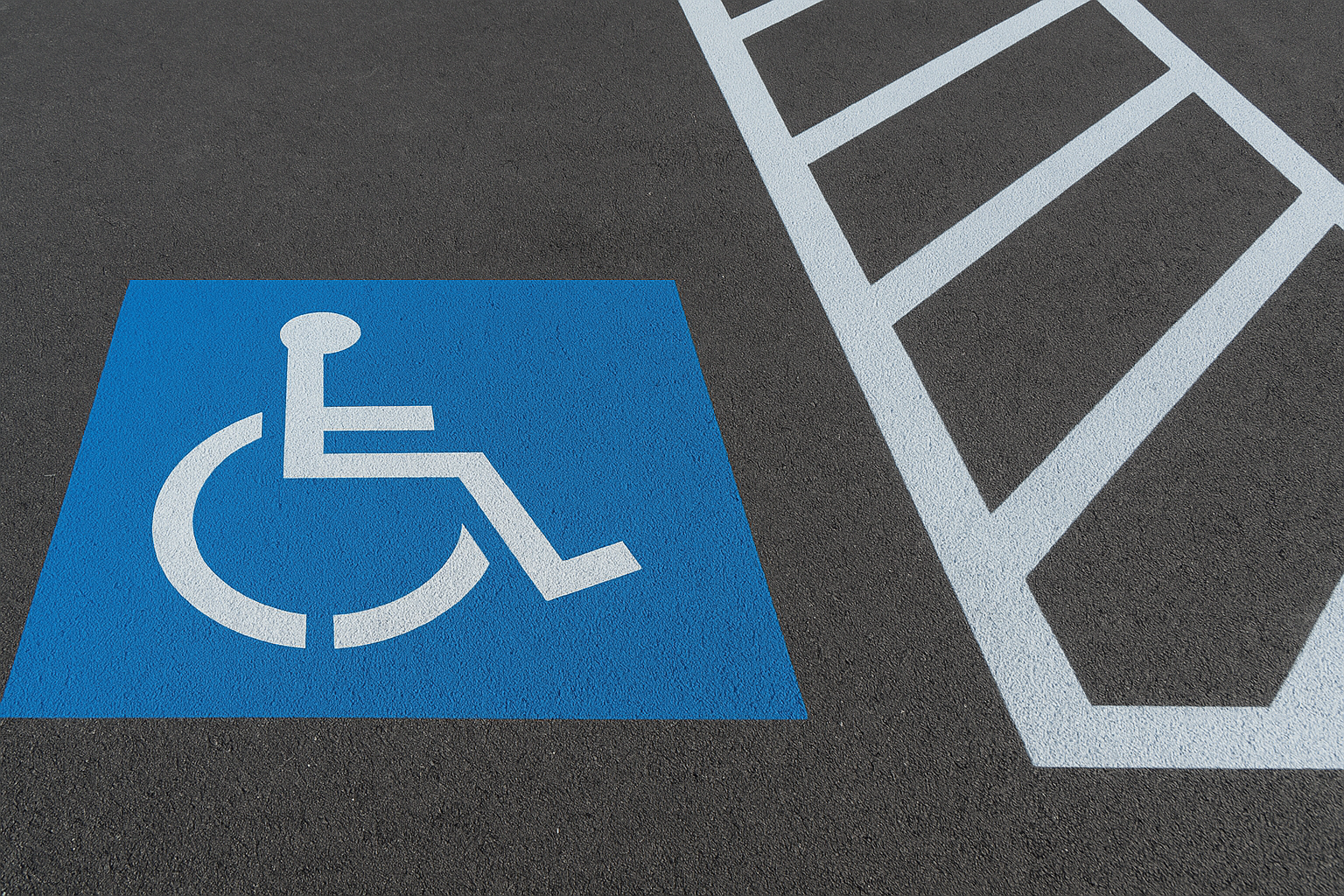
The diagonal hatched lines next to the blue spot are not just decoration. This is the “safe zone” for a wheelchair user to transfer from their car.
- Must be marked: Usually with diagonal hatch marks (we use high-visibility yellow or blue).
- No Parking: Drivers cannot park here, even for “just a minute.”
- Connection: The aisle must connect directly to an accessible route (sidewalk or ramp) without forcing the person to wheel behind parked cars.
The Silent Killer — Slope and Grade
You can have perfect lines and brand new signs, but if your asphalt is uneven, you will fail an ADA inspection.
2.1 The “2% Rule”
The ADA mandates that the parking space and the access aisle must be effectively level.
- Maximum Slope: 1:48 ratio (approximately 2.08%) in any direction.
This is incredibly flat. For context, a standard parking lot is pitched at 3% to 5% to drain water effectively. This creates a conflict: you need water to drain, but you need the spot to be flat.
2.2 The “Construction Tolerance” Trap
Many architects design handicap spots at exactly 2.0%.
This is a mistake.
Asphalt is not a factory-made product; it is laid by heavy machinery and rolled by humans. If you aim for 2.0% and the roller hits a bump, you might end up at 2.2%. 2.2% is a violation.
Our Expert Strategy: At Lancaster Lines & Asphalt, when we correct grades, we aim for a 1.5% slope. This 0.5% “buffer zone” ensures that even with minor field variances, you remain 100% legally compliant.
Technical Solutions for Slope Correction
What if your current handicap spots are on a hill or have settled into “birdbaths” (puddles)? You cannot just paint over it.
3.1 Infrared Asphalt Restoration (The Surgical Approach)
For minor slope issues or heaving, we use Infrared Patching. This is superior to “cut and patch” for ADA work because it creates a seamless bond.
- Heating: We superheat the existing asphalt to 325°F using an infrared panel.
- Scarifying: We rake the softened asphalt to a depth of 2-3 inches.
- Amending: We add fresh hot-mix asphalt to bring the grade up to that perfect 1.5% target.
- Compaction: We vibrate and roll it flush.Result: A perfectly level pad with no seams for water to enter.
3.2 Full Depth Reconstruction
If the sub-base has failed (alligator cracking), we must excavate. We remove the asphalt, re-grade the stone base with a laser level to ensure the slope is correct, and pave fresh.
Part 4: Materials Matter — Paint and Detectable Warnings
In Pennsylvania, we don’t just deal with traffic; we deal with salt, snow plows, and freeze-thaw cycles. Using the wrong materials is literally washing money down the drain.
4.1 Traffic Paint: Latex vs. Solvent vs. Thermoplastic
- Standard Water-Based (Latex): Cheap and eco-friendly. It’s fine for Southern states. In PA? It often peels after one tough winter.
- Solvent-Based (Oil/Acetone): The Pennsylvania Standard. This paint “bites” into the asphalt chemically. It can be applied in colder temperatures (down to 40°F) and resists lifting from snow plow blades better than latex.
- Thermoplastic: This is melted plastic fused to the road. It lasts 5+ years but is expensive. We recommend this for “Stop Bars” and crosswalks at high-traffic shopping centers.
Our Recommendation: For most parking lots in Lancaster, we use SetFast® or Chlorinated Rubber solvent paints. They provide the best balance of brightness, durability, and cost.
4.2 Detectable Warning Surfaces (Truncated Domes)
You’ve seen these: the bumpy pads at the bottom of curb ramps. They alert visually impaired pedestrians that they are entering traffic.
- The Law: Required at the bottom of curb ramps.
- Color: Must contrast with the surrounding surface. In PA, Red (brick red) or Yellow are the standards on concrete sidewalks.
Material Warning: Do not use the cheap “glue-down” rubber mats. PA snow plows will rip them up in one season.
- Best: Cast-in-place Cast Iron (Indestructible, rusts to a natural patina).
- Good: Rigid Composite tiles anchored with stainless steel bolts.
Part 5: Pennsylvania Specifics — Signs and Fines
The Federal ADA sets the baseline, but Pennsylvania adds its own layer of rules regarding signage.
5.1 The Signage Rules (R7-8)
Painting the wheelchair symbol on the ground is not enough. Snow covers the ground. You must have vertical signs.
- Height: The bottom edge of the sign must be 60 inches (5 feet) above the ground.
- Placement: Centered at the head of the parking space.
- The Sign: Must use the standard R7-8 “Reserved Parking” sign with the Blue ISA (International Symbol of Accessibility).
5.2 The “Van Accessible” Placard
Every van space must have a separate “VAN ACCESSIBLE” sign mounted below the main sign. Missing this little $30 placard is one of the most common reasons for failed inspections.
5.3 The Penalty Sign (PA Requirement)
Under Pennsylvania Title 75 (Vehicle Code), you are required to post the specific penalty for illegal parking.
- Text: “Violators Subject to Fine and Towing.”
- Placement: Usually mounted below the main sign or at the entrance of the lot.
- Why it matters: If you don’t have this sign, police or towing companies often legally cannot tow an offender from your private lot.
Part 6: Winter Maintenance & The Law
In Pennsylvania, ADA compliance doesn’t hibernate.
The “Snow Pile” Violation:
It is illegal to pile snow into handicap spaces or access aisles.
If your plow guy pushes a mountain of snow into the “striped area” because “no one parks there,” he has just blocked the access aisle. If a disabled customer cannot exit their vehicle, you are liable.
- Action Plan: Review your contract with your snow removal contractor. Explicitly state: “No snow storage in ADA spaces or access aisles.”
Part 7: Looking Ahead — 2026 Code Updates
Pennsylvania is currently updating its Uniform Construction Code (UCC). By January 1, 2026, the state is expected to fully adopt the 2021 International Building Code (IBC) standards.
What does this mean for you?
- EV Charging Stations: New codes have specific requirements for “Accessible EV Charging Spots.” If you plan to install Tesla or ChargePoint stations, they must meet ADA slope and width requirements just like parking spots.
- Stricter Enforcement: With the code update usually comes a wave of fresh inspections by municipal officers.
Getting your lot compliant in 2026 puts you ahead of the curve before the 2027 rush.
Part 8: The DIY Trap — Why You Should Never Stripe Your Own ADA Spots
We see it often: a business owner buys a bucket of blue paint and a stencil from a hardware store.
Here is why this is a liability disaster:
- Wrong Blue: ADA requires a specific “Safety Blue” (Federal Color 15090). Hardware store blue is often wrong.
- Wrong Paint: Typical “porch and floor” paint causes asphalt to crack or peels instantly.
- Crooked Lines: If you paint by hand without a line striper machine, lines will be wavy. Wavy lines look unprofessional and invite scrutiny.
- Overspray: Aerosol cans leave fuzzy edges. Crisp, sharp edges are the hallmark of a professional job.
The Cost of “Saving Money”: A professional re-stripe of a handicap spot might cost $150-$300. A lawsuit settlement starts at $10,000. It is simply not worth the risk.
Summary Checklist: Is Your Lot Legal?
Take this checklist to your parking lot today. If you answer “NO” to any of these, call us immediately.
- [ ] Do you have the correct number of spots based on the chart in Part 1?
- [ ] Is there a “Van Accessible” sign on at least one post?
- [ ] Are the signs at least 60 inches high?
- [ ] Is the asphalt in the blue spots perfectly flat (no puddles, no steep slope)?
- [ ] Are the diagonal cross-hatch lines clearly visible?
- [ ] Is there a smooth path from the access aisle to your front door (no curb jump)?
Need an Audit?
At Lancaster Lines & Asphalt, we offer comprehensive ADA Compliance Audits. We measure your slopes with digital levels, check your sign heights, and inspect your layout.
We don’t just point out problems; we engineer solutions. Whether you need a simple re-stripe, sign installation, or infrared slope correction, we handle it all in-house.
Don’t wait for a letter from an attorney.
Contact us today for your Free ADA Compliance Assessment
📞 Call Now: (717) 454-9931
Frequently Asked Questions (FAQ)
Q: Can I put the handicap spot in the back of the lot if it’s flatter there?
A: No. The ADA strictly requires accessible spaces to be located on the shortest accessible route to the entrance. You cannot sacrifice location for slope; you must fix the slope near the entrance.
Q: Do grandfather rights apply to old parking lots?
A: Generally, no. The ADA requires “barrier removal” that is “readily achievable.” Repainting a parking lot is considered readily achievable and cheap. If you restripe your lot, you must bring the handicap spots up to current 2010 standards. There is no grandfathering for striping.
Q: My lot is small (4 spaces). Do I need a handicap spot?
A: Yes. Even if you have a tiny lot (1-25 spaces), you must have at least one accessible spot, and it must be Van-Accessible.
Disclaimer: This article is for informational purposes only and does not constitute legal advice. For specific legal questions regarding ADA lawsuits, please consult a qualified attorney.
Tags: #ADAParking #LancasterPA #PropertyManagement #AsphaltMaintenance #LineStriping #BusinessLaw #SafetyCompliance